On this page
- Choose the customer moment
- Segment by role and use case
- Build around tasks
- Decide where human support matters
- Measure useful signals
- Keep content current
- What to look for in a customer education platform
- AcadifyLab context
- Action checklist
- Related AcadifyLab resources
- Next step
- Frequently asked questions
- Conclusion
- Further reading
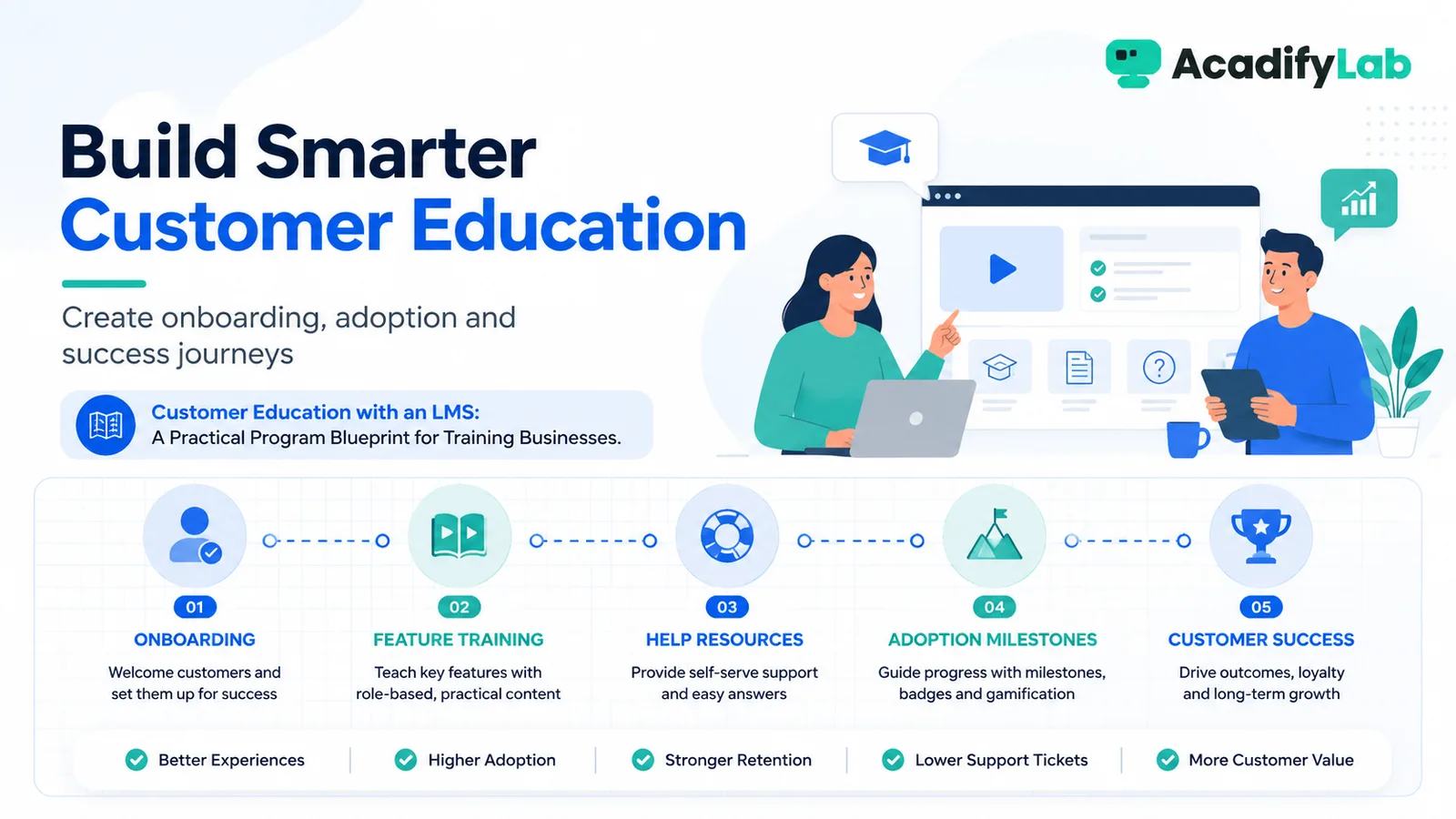
Customer education uses structured learning to help customers understand a product or service, reach value sooner and build deeper capability. A successful program begins with customer outcomes, not with converting internal documentation into a course library.
The practical approach is to start from the learning and operating problem, define the minimum workflow that solves it, and then use technology to make that workflow consistent. This guide focuses on decisions that can be tested in a real LMS rather than on feature-count marketing.
Choose the customer moment
Common starting points include onboarding, first successful use, advanced adoption, administrator training and certification.
Segment by role and use case
Different customers may need different paths. An end user, administrator and implementation partner should not be forced through the same sequence.
Build around tasks
Organise lessons around what customers need to accomplish. Product tours, short demonstrations, checklists and scenario practice often work better than long feature lectures.
Decide where human support matters
Use self-paced learning for repeatable guidance and live sessions for complex setup, Q&A or advanced workshops.
Measure useful signals
Track enrolment, progress, assessment results and certification where relevant. Connect learning data to customer outcomes only when your organisation has a valid measurement model.
Keep content current
Customer education ages quickly when the product changes. Assign owners and review dates for each learning path.
What to look for in a customer education platform
- Separate spaces per customer account, so each customer sees only their own training and reports. See multi-tenant LMS.
- Sign-ups limited to a customer’s email domain, so access follows the account.
- Your brand on the academy, so training feels like part of your product. See white label LMS.
- Short, task-based courses with quick checks, and certificates for customers who want proof of skill.
- Live onboarding sessions alongside self-paced content, with attendance recorded.
- Integrations with your CRM or product, so training activity is visible to account teams.
AcadifyLab context
AcadifyLab positions its enterprise solution for employees, partners and customers and provides branded learning, analytics and role-based access. Training businesses can evaluate it for customer-facing academies as well as internal learning.
Action checklist
- Review and document: choose the customer moment.
- Review and document: segment by role and use case.
- Review and document: build around tasks.
- Review and document: decide where human support matters.
- Review and document: measure useful signals.
- Review and document: keep content current.
Use the checklist with a real course, batch or training program. Record any exception that still requires a spreadsheet, manual message or separate tool; those exceptions are often the most useful questions to raise during a trial or vendor demo.
Related AcadifyLab resources
Explore the AcadifyLab features overview and the relevant solution page for your use case.
Enterprise LMS for training companies
Next step
If you need to validate a multi-step workflow, a live product walkthrough is the fastest way to test requirements against the platform before committing.
Frequently asked questions
What is customer education?
Customer education is structured learning that helps customers adopt, use and gain value from a product or service.
Is customer education the same as support documentation?
No. Documentation answers reference questions; customer education usually creates guided learning journeys around outcomes and tasks.
Who should own customer education?
Ownership varies by organisation and may sit with customer success, education, enablement or training teams.
Should customer education be free?
It can be free, paid or bundled with a service depending on strategy and the depth of training.
What should a customer education LMS track?
Track participation, progress, assessments or certification where relevant, while connecting to business outcomes only with a valid measurement model.
Conclusion
Customer Education with an LMS is ultimately a workflow decision, not a checklist contest. Define what learners and administrators need to accomplish, keep the process simple enough to operate consistently, and use the LMS to make that process visible and repeatable. For training enterprises, that approach is more durable than choosing technology around whichever feature happens to be trending.
Further reading
Related articles