On this page
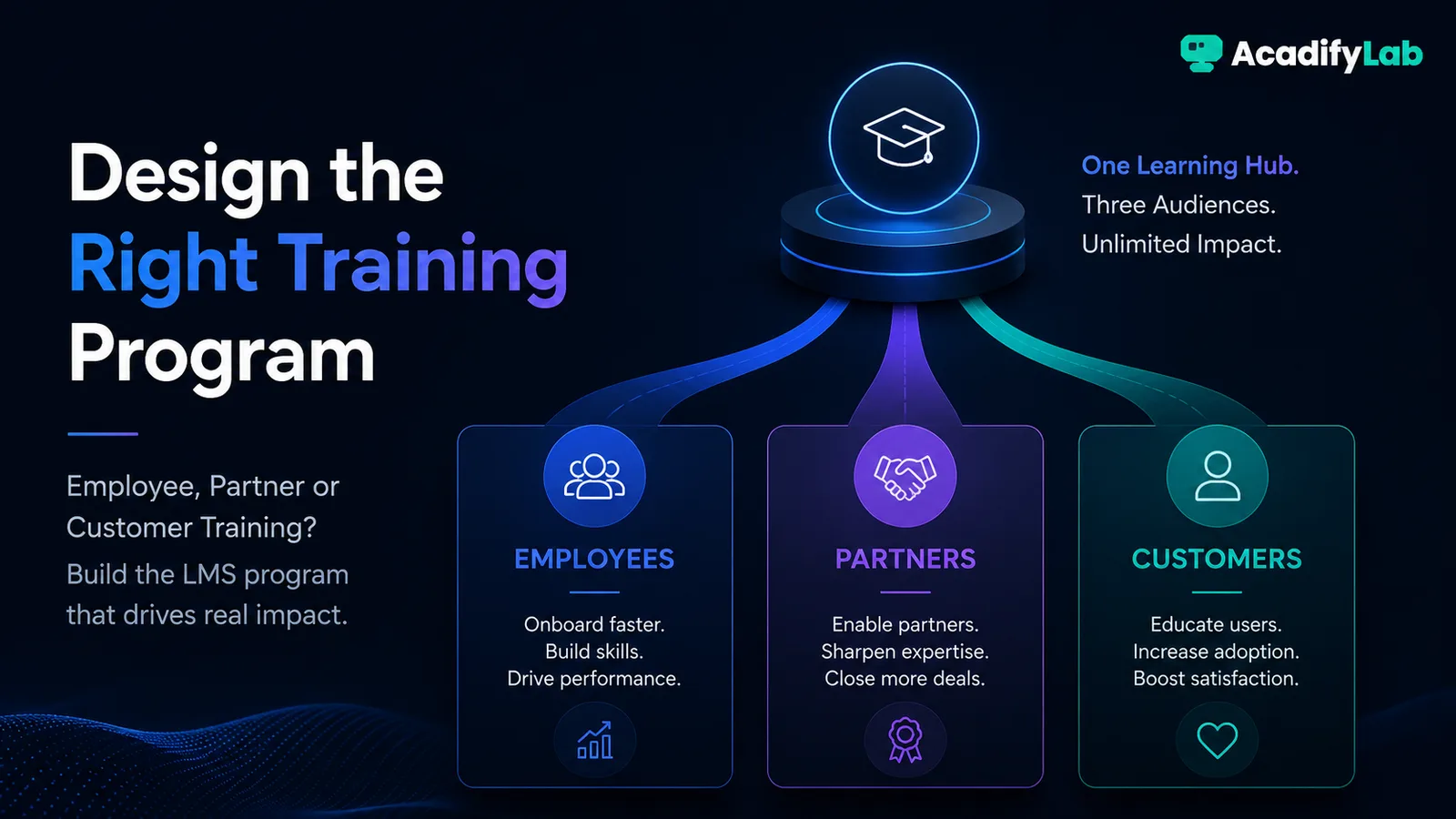
Employee, partner and customer training can share one learning platform, but they should not share one undifferentiated program. Each audience has different goals, access rules, content depth, certification needs and reporting stakeholders.
The practical approach is to start from the learning and operating problem, define the minimum workflow that solves it, and then use technology to make that workflow consistent. This guide focuses on decisions that can be tested in a real LMS rather than on feature-count marketing.
Employee training
Employee learning often covers onboarding, role skills, policy, compliance and career development. Access is usually tied to role, department or location, and managers may need completion and competency visibility.
Partner training
Partners, resellers and franchisees often need product knowledge, sales enablement, operating standards or certification. The program should make external access simple while separating partner groups and protecting internal material.
Customer education
Customer learning is usually focused on adoption, onboarding, best practices and advanced product use. The experience should be easy to enter, closely aligned with the brand and designed around customer outcomes rather than internal HR processes.
What changes across audiences
Use the following points as a working checklist for training enterprises:
- Identity and access
- Enrolment rules
- Content permissions
- Branding and communications
- Certification rules
- Reporting stakeholders
- Data retention and support model
When to use one LMS
One platform can make sense when the organisation needs consistent governance, common reporting patterns, reusable content and centralized administration while still segmenting audiences through roles, groups or branches.
When separate experiences are necessary
If audiences require fundamentally different branding, legal terms, privacy boundaries or operational teams, separate portals or stronger segmentation may be needed even if the underlying technology is shared.
AcadifyLab context
AcadifyLab describes its enterprise offering for employees, partners and customers, with role-based access, internal certification, compliance training, team analytics and reporting. A demo should validate how those controls map to your external and internal audiences.
Action checklist
- Review and document: employee training.
- Review and document: partner training.
- Review and document: customer education.
- Review and document: what changes across audiences.
- Review and document: when to use one lms.
- Review and document: when separate experiences are necessary.
Use the checklist with a real course, batch or training program. Record any exception that still requires a spreadsheet, manual message or separate tool; those exceptions are often the most useful questions to raise during a trial or vendor demo.
Related AcadifyLab resources
Explore the AcadifyLab features overview and the relevant solution page for your use case.
Enterprise LMS for training companies
Next step
If you need to validate a multi-step workflow, a live product walkthrough is the fastest way to test requirements against the platform before committing.
Frequently asked questions
What is extended enterprise learning?
It generally refers to training audiences outside the employee base, such as partners, customers, distributors, franchisees or contractors.
Can the same LMS train employees and customers?
Yes, if it supports appropriate audience segmentation, permissions, branding and reporting. The learning experiences should still be designed separately.
Do customer training programs need certificates?
Only when certification adds value, such as proving product competency or completion. Many customer education programs focus more on adoption than formal certification.
What should partner training measure?
Depending on the program, measure participation, assessment performance, certification status and completion of required product or process learning.
How should training enterprises choose audience groups?
Group learners according to purpose and access needs, not simply by organisation name. Each group should have a clearly defined journey and reporting owner.
Conclusion
Employee, Partner or Customer Training? How to Design the Right LMS Program is ultimately a workflow decision, not a checklist contest. Define what learners and administrators need to accomplish, keep the process simple enough to operate consistently, and use the LMS to make that process visible and repeatable. For training enterprises, that approach is more durable than choosing technology around whichever feature happens to be trending.
Further reading
Related articles