On this page
- Compare the business model
- Side by side
- Brand ownership
- Learner relationship and data
- Revenue and cost structure
- When a marketplace makes sense
- When a white-label platform makes sense
- Can you do both?
- AcadifyLab context
- Decision checklist
- Related AcadifyLab resources
- Next step
- Frequently asked questions
- Conclusion
- Further reading
A white-label LMS gives trainers more control over brand and learner experience, while a course marketplace offers built-in distribution but usually places the marketplace brand and rules between the trainer and the learner.
The choice is rarely about features. It is about which side of the relationship you want to own: a marketplace owns discovery and the learner account, while a white label online course platform puts your brand, domain and learner data on your side of the line. This guide compares the two on the five things that actually differ, and ends with the case for doing both.
Compare the business model
Use the following points as a working checklist for individual trainers/educators:
- Marketplace: easier discovery can be valuable, but the platform defines much of the storefront and commercial experience.
- White-label LMS: the trainer is responsible for audience building but gains greater control over presentation, pricing approach and learner relationship.
Side by side
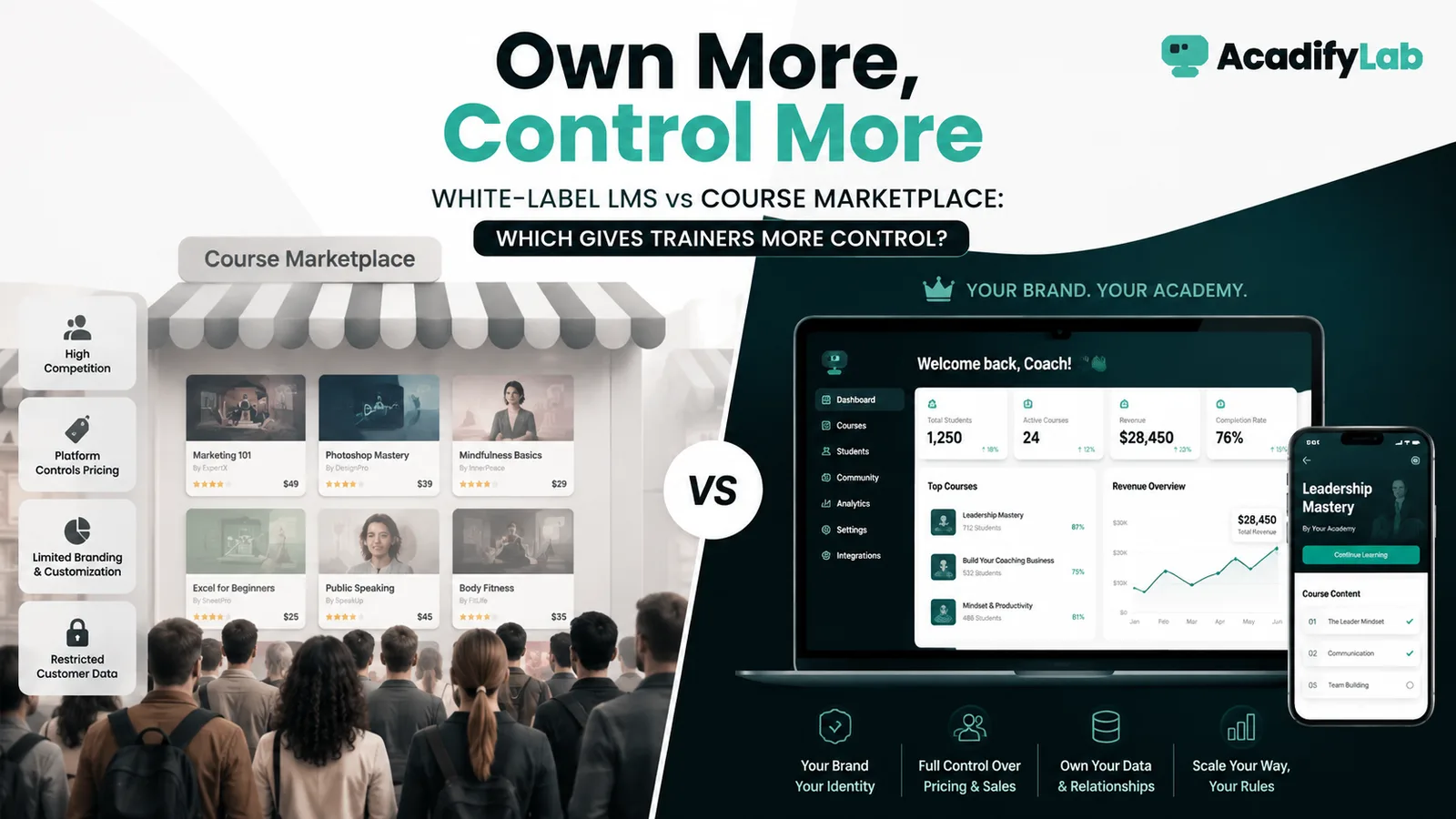
| Course marketplace | White-label platform | |
|---|---|---|
| Who finds the learner | The marketplace | You |
| Whose brand they remember | The marketplace | Yours |
| Who owns the learner list | Usually the marketplace | You |
| Pricing control | Constrained by platform rules and discounting | Yours |
| Cost shape | Commission per sale | Subscription, ideally without revenue share |
| Effort to start | Low | Moderate |
| Effort to grow | Rises with competition on the platform | Rises with your own marketing |
The row that decides it for most trainers is the third one. Everything else can be worked around; a learner list you cannot export is the one thing you cannot rebuild later.
Brand ownership
Check who controls the domain, app identity, visual branding, emails, notifications and learner-facing support. “Custom logo” is not the same as a fully branded experience.
Learner relationship and data
Understand what learner records, communication channels and analytics you can access and export. The platform should be evaluated for portability as well as day-to-day convenience.
Revenue and cost structure
Compare subscription fees, transaction or revenue-share charges, payment-gateway fees and optional services. The lowest monthly fee is not always the lowest total cost.
When a marketplace makes sense
A marketplace can suit a trainer who values discovery and wants minimal operating responsibility, especially while validating demand.
When a white-label platform makes sense
A branded platform is more suitable when the trainer wants a durable business identity, direct learner communication, flexible course formats and ownership of the learning experience.
Can you do both?
Most trainers treat this as either/or. It usually is not. A common pattern is to run a short, cheap introductory course on a marketplace purely for discovery, and to run the full programme on your own platform — using the marketplace as a top-of-funnel channel rather than a home.
Two cautions if you do. Check the marketplace’s terms on directing learners elsewhere, because some prohibit it outright. And keep the two catalogues genuinely different: selling the same course in both places mostly trains your audience to buy it wherever it is cheapest.
AcadifyLab context
AcadifyLab positions itself as a white-label LMS with branded apps, custom domain/identity, course monetization and zero revenue sharing. Trainers should still compare the full operating cost and the responsibilities they are prepared to own.
Decision checklist
Answer these before choosing, not after:
- Can you export learner names and emails, in a usable format, without asking support?
- If you left tomorrow, what would you keep — the audience, the content, the reviews, none of it?
- Is your commission on a sale higher or lower than a flat subscription at your expected volume? Work it out at your current numbers, not your target ones.
- Do you need your own domain and app, or is a profile page enough for now?
- Who answers a learner’s refund request — you, or the platform?
- Is discovery actually your bottleneck? If you already have an audience, you are paying a marketplace for something you do not need.
Related AcadifyLab resources
Explore the AcadifyLab features overview and the relevant solution page for your use case.
White-label course platform for trainers
What actually gets branded when you white-label an LMS
How to build an online course platform: three routes
Next step
Once the workflow fit is clear, compare the current plan structure and total operating cost for your expected usage.
Frequently asked questions
What is a course marketplace?
A course marketplace hosts courses from many creators under the marketplace brand and may also provide discovery, checkout and learner accounts.
What is a white-label LMS?
A white-label LMS lets an educator or organisation present the learning platform under its own brand rather than the software vendor’s learner-facing brand.
Which is better for a new trainer?
A marketplace can be useful for discovery; a white-label platform can be better for long-term brand ownership. The right choice depends on audience acquisition and operating goals.
Does white-label always mean a branded mobile app?
No. White-label can range from logo and colours to custom domain and native apps. Verify exactly what is included.
What costs should trainers compare?
Compare subscription, revenue share, payment fees, apps, storage, support and marketing responsibility.
Conclusion
Marketplaces sell reach; white-label platforms sell ownership. If you cannot yet fill a cohort, reach is worth more and the commission is a fair price for it. Once you can fill a cohort from your own list, you are paying a percentage for something you are already doing yourself — and that is the point at which the arithmetic reverses. Decide which of those two sentences describes you today, and revisit it every few months, because the answer changes.
Further reading
Related articles