
On this page
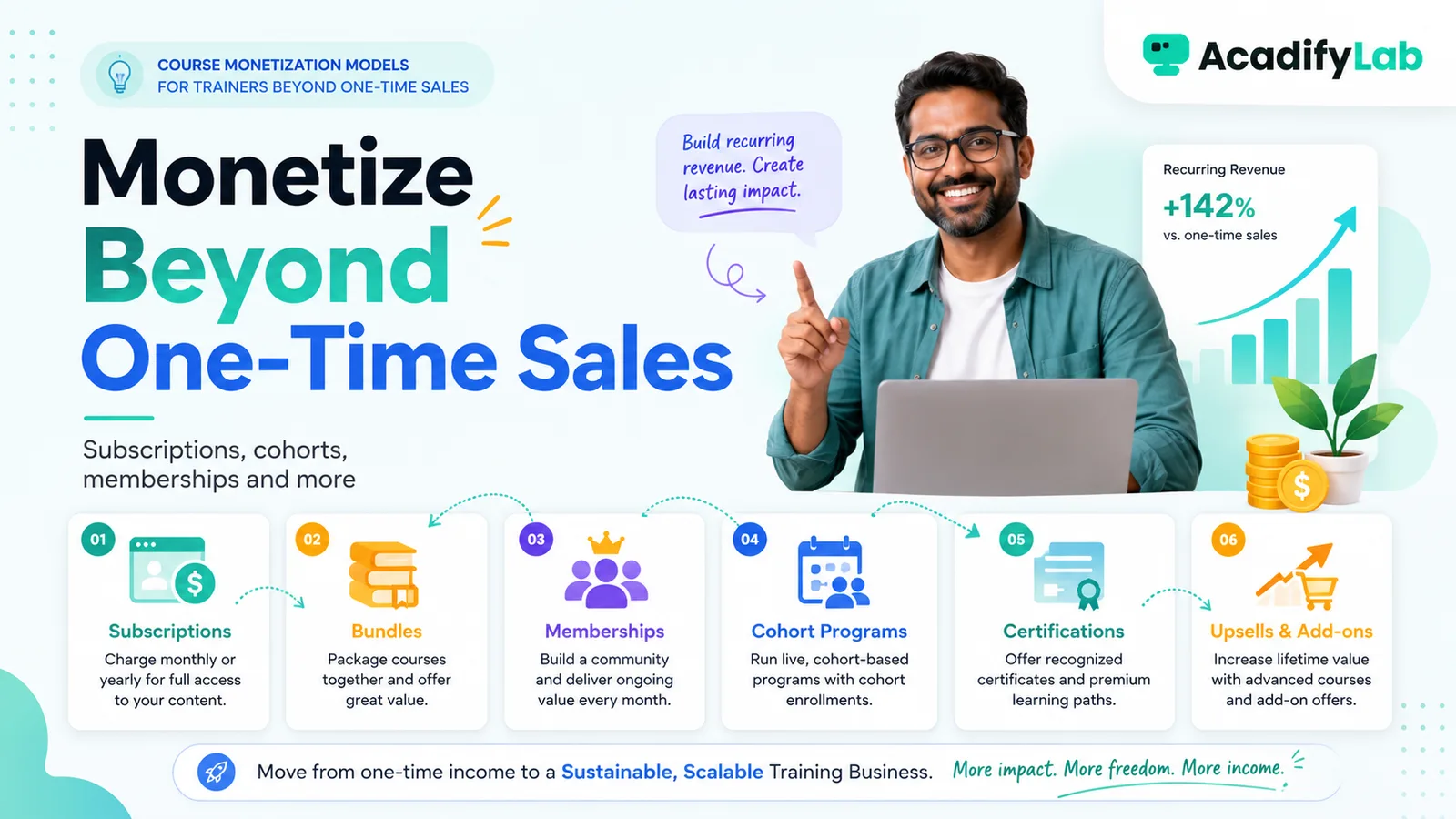
Trainers do not have to rely only on one-time course sales. Cohorts, memberships, bundles, workshops and blended offers can create different value propositions and revenue patterns. The right model depends on how much ongoing access, interaction and new content you can sustainably deliver.
The practical approach is to start from the learning and operating problem, define the minimum workflow that solves it, and then use technology to make that workflow consistent. This guide focuses on decisions that can be tested in a real LMS rather than on feature-count marketing.
One-time evergreen course
Best when the learning outcome can be delivered largely asynchronously and the content remains useful for a reasonable period.
Cohort-based program
Useful when learners benefit from a shared start date, live interaction, deadlines and peer accountability.
Membership
Works when learners receive continuing value such as new resources, community, office hours, updates or recurring workshops.
Course bundles and learning paths
Combine related courses around a larger outcome. Bundles should solve a coherent problem rather than simply discount unrelated products.
Paid workshops or masterclasses
A focused live event can serve as a standalone offer, a lead-in to a larger program or an advanced add-on.
Hybrid offer
Combine recorded foundations with live coaching or review. Price according to the scarce element: instructor time, feedback depth and access.
Use pricing as a separate decision
This article focuses on monetization models. For price-setting, link internally to AcadifyLab’s existing article on how to price online courses in India.
AcadifyLab context
AcadifyLab’s trainer page lists course monetization for courses, memberships and cohorts, live workshops, branded apps and zero revenue sharing, which aligns with several of these models.
Action checklist
- Review and document: one-time evergreen course.
- Review and document: cohort-based program.
- Review and document: membership.
- Review and document: course bundles and learning paths.
- Review and document: paid workshops or masterclasses.
- Review and document: hybrid offer.
Use the checklist with a real course, batch or training program. Record any exception that still requires a spreadsheet, manual message or separate tool; those exceptions are often the most useful questions to raise during a trial or vendor demo.
Related AcadifyLab resources
Explore the AcadifyLab features overview and the relevant solution page for your use case.
White-label course platform for trainers
Next step
Once the workflow fit is clear, compare the current plan structure and total operating cost for your expected usage.
Frequently asked questions
What is course monetization?
It is the way a trainer packages and charges for learning products, such as courses, cohorts, memberships or workshops.
Is a membership better than a one-time course?
Only if you can provide continuing value that justifies recurring access.
Can a trainer combine a course and live coaching?
Yes. Hybrid offers commonly pair recorded lessons with workshops, office hours or feedback.
Should bundles always be discounted?
No. A bundle should have a coherent outcome; discounting is a pricing choice, not the definition of a bundle.
How should trainers choose a model?
Match the model to learner needs, instructor time, content update frequency and the type of transformation promised.
Conclusion
Course Monetization Models for Trainers Beyond One-Time Sales is ultimately a workflow decision, not a checklist contest. Define what learners and administrators need to accomplish, keep the process simple enough to operate consistently, and use the LMS to make that process visible and repeatable. For individual trainers/educators, that approach is more durable than choosing technology around whichever feature happens to be trending.
Related articles