On this page
- Define the transformation before the syllabus
- Turn the outcome into modules
- Use a repeatable lesson pattern
- Decide what should be live and what should be asynchronous
- Build assessment into the design
- Design for completion, not content volume
- How an LMS supports the framework
- Action checklist
- Related AcadifyLab resources
- Next step
- Frequently asked questions
- Conclusion
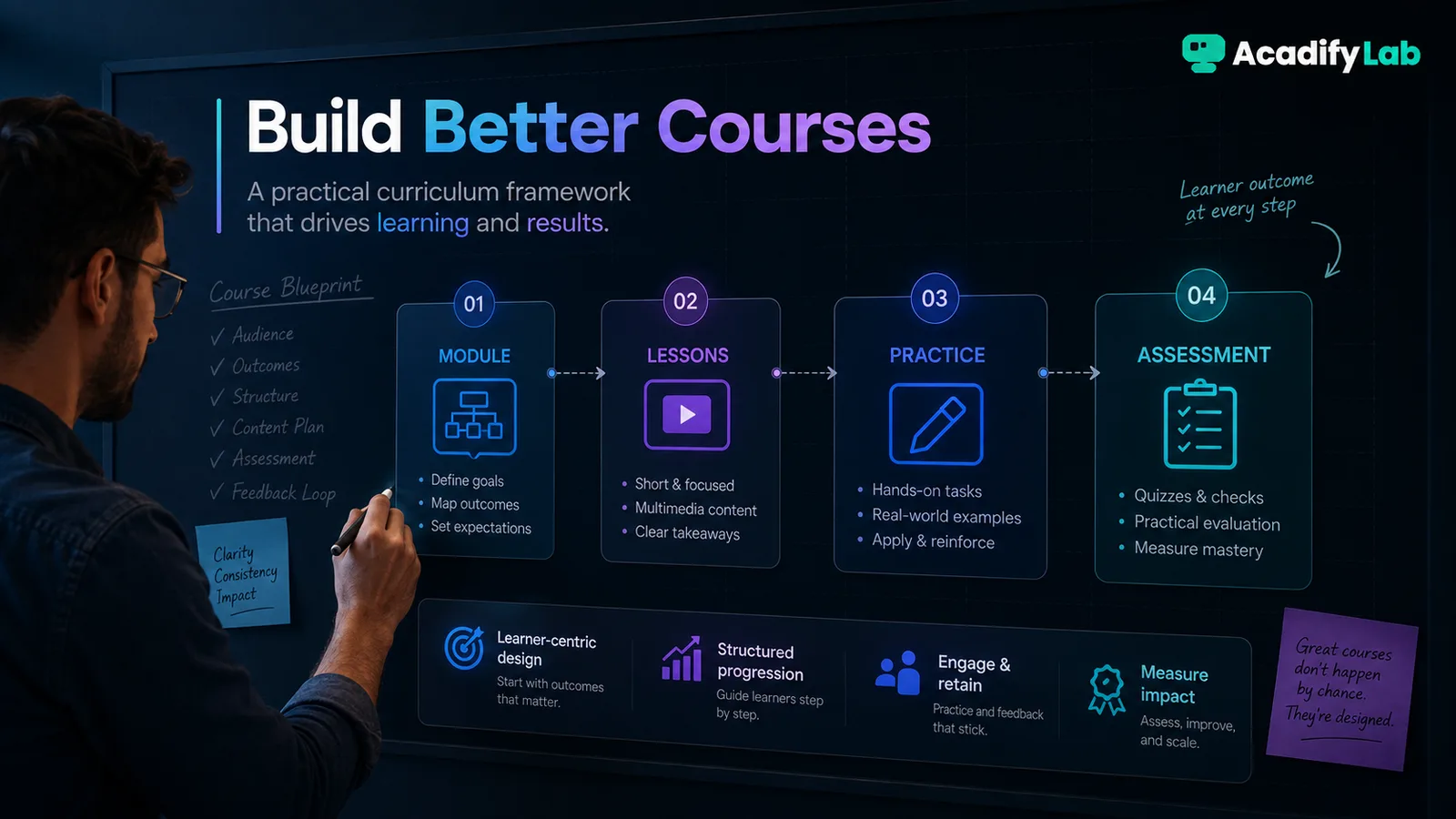
A strong online course is structured around a learner outcome, not around everything the trainer knows. Start with the result learners should achieve, break that result into milestones, design practice for each milestone, and only then decide which videos, live sessions, notes and assessments are needed.
The practical approach is to start from the learning and operating problem, define the minimum workflow that solves it, and then use technology to make that workflow consistent. This guide focuses on decisions that can be tested in a real LMS rather than on feature-count marketing.
Define the transformation before the syllabus
Use the following points as a working checklist for individual trainers/educators:
- Write one outcome statement: “By the end of this course, learners can…”
- Describe who the course is for and what they should already know.
- List the real-world tasks that prove the learner has achieved the outcome.
Turn the outcome into modules
A useful module represents a meaningful stage in the learner journey. Instead of creating modules such as “Introduction,” “More Concepts” and “Advanced Topics,” name them around capability: understand the foundation, perform the first workflow, solve common problems, and complete a real project.
Use a repeatable lesson pattern
Use the following points as a working checklist for individual trainers/educators:
- Context: why this lesson matters.
- Instruction: explain or demonstrate one core concept.
- Practice: ask the learner to apply it.
- Feedback: show how to self-check or get instructor feedback.
- Next step: connect the lesson to the next module.
Decide what should be live and what should be asynchronous
Recorded lessons are useful for repeatable explanations and demonstrations. Live sessions are better for critique, discussion, problem-solving and questions that benefit from instructor interaction. A blended course can use both without making every lesson a webinar.
Build assessment into the design
Do not leave assessment until the final week. Use quick checks after concepts, practice tasks after modules and a final demonstration that mirrors the stated course outcome.
Design for completion, not content volume
More hours do not automatically mean more value. Remove lessons that do not help the learner reach the promised outcome. Break long modules into navigable units and make progress visible.
How an LMS supports the framework
A platform such as AcadifyLab can organise courses, live classes, assessments, certificates, community discussions and learner analytics in one branded environment. The technology should support the curriculum rather than dictate it.
Action checklist
- Review and document: define the transformation before the syllabus.
- Review and document: turn the outcome into modules.
- Review and document: use a repeatable lesson pattern.
- Review and document: decide what should be live and what should be asynchronous.
- Review and document: build assessment into the design.
- Review and document: design for completion, not content volume.
Use the checklist with a real course, batch or training program. Record any exception that still requires a spreadsheet, manual message or separate tool; those exceptions are often the most useful questions to raise during a trial or vendor demo.
Related AcadifyLab resources
Explore the AcadifyLab features overview and the relevant solution page for your use case.
White-label course platform for trainers
Next step
If this workflow matches what you are trying to build, test it with your own sample course, batch or training program rather than relying on screenshots alone.
Frequently asked questions
How many modules should an online course have?
There is no ideal number. Use as many modules as needed to represent distinct learner milestones. A short course may need only a few; a professional program may require many more.
How long should an online lesson be?
Lesson length should follow the task. A focused explanation may be short, while a worked example or workshop can be longer. Avoid splitting or stretching content only to hit a target duration.
Should every module have a quiz?
Not necessarily. Use quizzes when recall or conceptual understanding matters. For skills, a practical task, submission or live review can be more meaningful.
Should trainers record the full course before launching?
Not always. Cohort-based courses can validate the curriculum live before producing polished recordings. Evergreen courses usually benefit from a more complete content library before launch.
What is the best way to improve a course after launch?
Review learner questions, assessment performance, completion patterns and feedback. Improve the lessons where learners repeatedly get stuck rather than rewriting everything.
Conclusion
How to Structure an Online Course is ultimately a workflow decision, not a checklist contest. Define what learners and administrators need to accomplish, keep the process simple enough to operate consistently, and use the LMS to make that process visible and repeatable. For individual trainers/educators, that approach is more durable than choosing technology around whichever feature happens to be trending.
Related articles