On this page
- What is blended learning?
- When live learning works best
- When recorded learning works best
- When blended learning is stronger than either alone
- A decision framework for trainers
- Common mistakes
- How to structure a blended course in an LMS
- AcadifyLab context
- Action checklist
- Related AcadifyLab resources
- Next step
- Frequently asked questions
- Conclusion
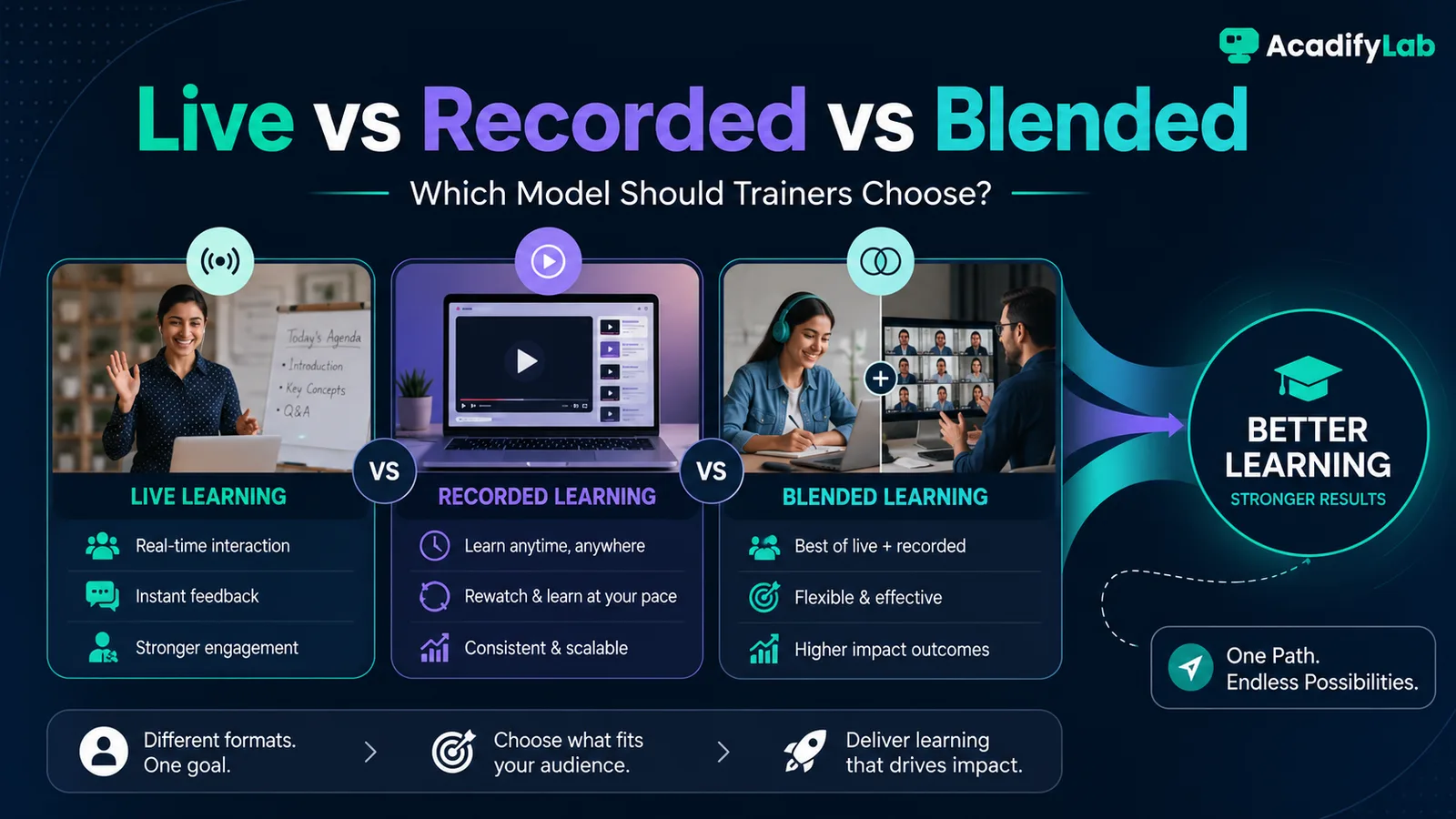
Choose live, recorded or blended learning based on the learning task. Recorded content is efficient for repeatable explanation; live learning is valuable for interaction, coaching and feedback; blended learning combines asynchronous preparation with synchronous practice when both are useful.
The practical approach is to start from the learning and operating problem, define the minimum workflow that solves it, and then use technology to make that workflow consistent. This guide focuses on decisions that can be tested in a real LMS rather than on feature-count marketing.
What is blended learning?
Blended learning combines self-paced online study with live, instructor-led sessions, so learners take in content on their own and use live time for practice, discussion and questions. It is sometimes called hybrid learning, although hybrid usually means the same live session is attended in person and online at once.
Common blended models include the flipped classroom, where learners watch recorded lessons before a live session that is spent on problems and questions; the rotation model, where a course alternates between recorded modules and live workshops; and the flex model, where most learning is self-paced with live support on demand. On an LMS, one course can hold the recorded lessons, the live-class schedule, attendance and the tests that check understanding. See how that works on an e-learning platform and in a virtual classroom.
When live learning works best
Use the following points as a working checklist for individual trainers/educators:
- Complex questions benefit from immediate clarification.
- Skills improve through critique, demonstration or coaching.
- The cohort benefits from discussion and peer learning.
- Accountability and scheduled momentum are important.
When recorded learning works best
Use the following points as a working checklist for individual trainers/educators:
- The explanation is repeatable and stable.
- Learners need flexible access across schedules.
- The material benefits from pause, rewind and revision.
- The trainer wants to serve more learners without repeating the same lecture live.
When blended learning is stronger than either alone
Use recordings or readings for foundational material, then reserve live time for application. After the live session, assign practice and make recordings or summaries available for revision. This makes synchronous time more valuable.
A decision framework for trainers
Use the following points as a working checklist for individual trainers/educators:
- Interaction intensity: how much instructor feedback is required?
- Learner flexibility: must learners study at different times?
- Content shelf life: how frequently will lessons change?
- Assessment type: knowledge check or demonstrated performance?
- Scale: can the trainer repeat the live workload sustainably?
Common mistakes
A recorded course fails when it is just a long lecture library with no practice. A live course fails when every session repeats basic explanations that could be asynchronous. A blended course fails when learners cannot tell what to do before, during and after each session.
How to structure a blended course in an LMS
Create a module with preparation, live session, follow-up task and assessment. Keep the calendar and learning path in one place so learners do not need to reconstruct the course from chat messages and meeting links.
AcadifyLab context
AcadifyLab lists recorded courses, Zoom and Google Meet live classes, scheduling, assessments, community discussions and mobile access. Trainers can use these capabilities to test a delivery model that matches their subject and audience.
Action checklist
- Review and document: when live learning works best.
- Review and document: when recorded learning works best.
- Review and document: when blended learning is stronger than either alone.
- Review and document: a decision framework for trainers.
- Review and document: common mistakes.
- Review and document: how to structure a blended course in an lms.
Use the checklist with a real course, batch or training program. Record any exception that still requires a spreadsheet, manual message or separate tool; those exceptions are often the most useful questions to raise during a trial or vendor demo.
Related AcadifyLab resources
Explore the AcadifyLab features overview and the relevant solution page for your use case.
White-label course platform for trainers
Next step
If this workflow matches what you are trying to build, test it with your own sample course, batch or training program rather than relying on screenshots alone.
Frequently asked questions
Are live courses better than recorded courses?
Neither is universally better. Live delivery is stronger for interaction and coaching; recorded delivery is stronger for flexibility and repeatable explanations.
Can a trainer sell both live and recorded learning?
Yes. Many programs use recorded foundations plus live workshops, office hours or cohort sessions.
What is blended learning?
Blended learning combines multiple delivery modes, commonly asynchronous lessons with scheduled live or classroom interactions.
Should live classes always be recorded?
Recording can help revision, but trainers should consider privacy, consent, content sensitivity and whether the session includes learner discussions.
How do I choose the right model for a new course?
Start from the outcome. If learners need feedback on performance, include live interaction. If they mainly need knowledge and practice at their own pace, recorded components can carry more of the course.
Conclusion
Live vs Recorded vs Blended Learning is ultimately a workflow decision, not a checklist contest. Define what learners and administrators need to accomplish, keep the process simple enough to operate consistently, and use the LMS to make that process visible and repeatable. For individual trainers/educators, that approach is more durable than choosing technology around whichever feature happens to be trending.
Related articles