
On this page
- What is instructional design?
- The ADDIE model explained
- Writing learning objectives that work
- Aligning assessments with objectives
- Worked example: a two-week sales onboarding programme
- ADDIE vs SAM and agile approaches
- Principles that make training effective
- Common instructional design mistakes
- Tools for instructional designers
- Frequently asked questions
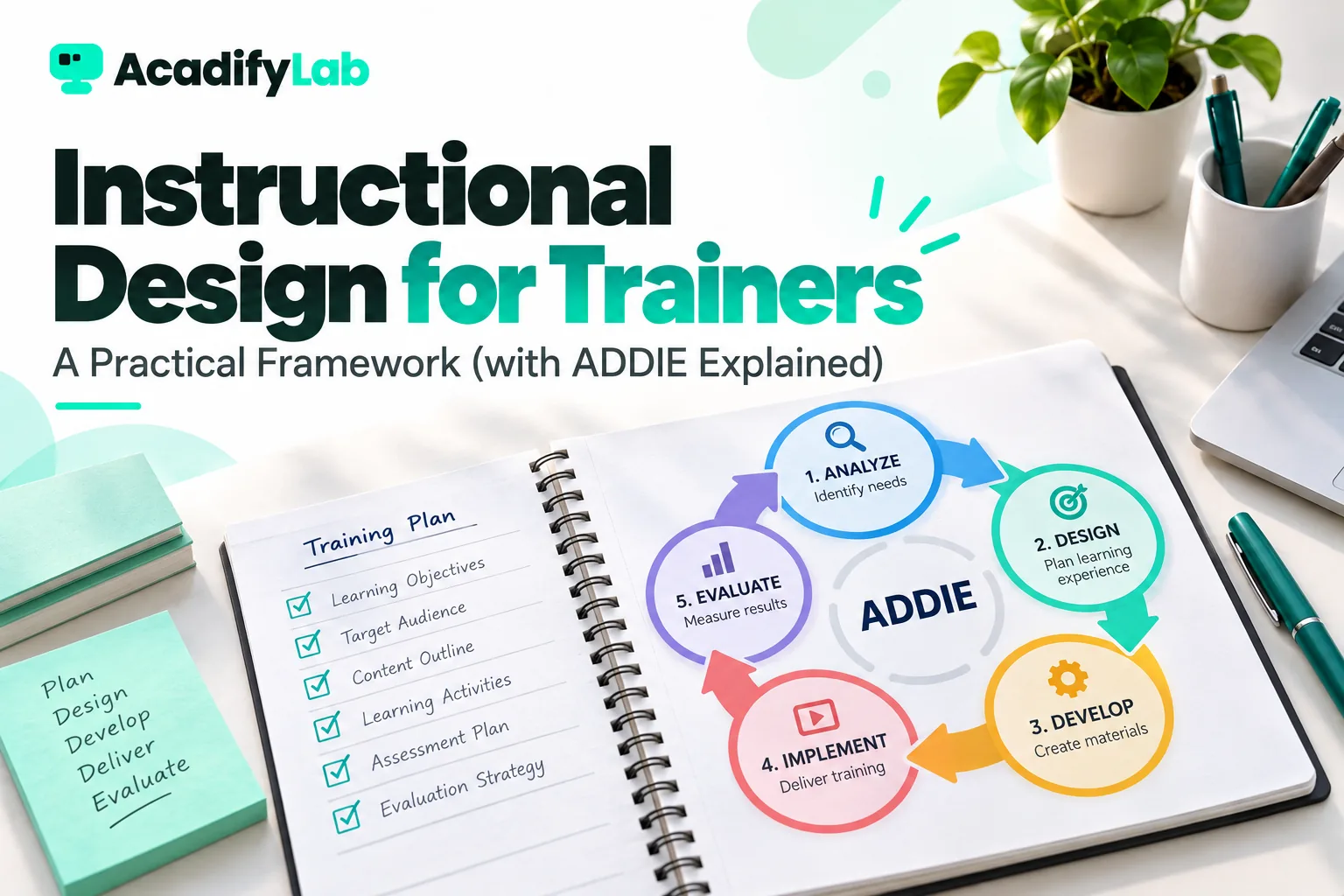
Instructional design is the process of planning training so that learners can actually do something new by the end of it. The most widely used framework is ADDIE: Analyse the need, Design objectives and assessments, Develop the materials, Implement the training and Evaluate whether it worked. Used practically, ADDIE stops trainers from building content first and asking what it is for later.
This guide explains each ADDIE phase in plain language, works through a real example of a two-week sales onboarding programme, and covers learning objectives, assessment alignment and when a faster, iterative approach such as SAM fits better.
Key takeaways
- Good instructional design starts with the performance problem, not with slides or videos.
- ADDIE has five phases: Analyse, Design, Develop, Implement and Evaluate. Each phase feeds the next.
- Write measurable learning objectives, then design assessments that test exactly those objectives.
- Practice and feedback do more for learning than more content.
- Use ADDIE for structured programmes, and an iterative model such as SAM when requirements change fast.
What is instructional design?
Instructional design is the systematic planning of learning experiences. It brings together what learners need to achieve, how people learn, and practical constraints such as time, budget, delivery format and technology. The result can be a classroom workshop, an online course, a blended programme or a short job aid.
Whether you are a corporate trainer, a coaching institute building a new course or an independent trainer creating a paid programme, the core questions are the same:
- What should learners be able to do afterwards that they cannot do now?
- How will we know they can do it?
- What practice, explanation and support will get them there?
- How will we deliver it, and how will we improve it next time?
The ADDIE model explained
ADDIE is a five-phase framework that originated in military and government training in the 1970s and became a standard in corporate and educational design. It is often drawn as a cycle, because evaluation feeds back into analysis for the next version. The ADDIE model is simple to remember, but each phase involves real decisions.
1. Analyse: define the real problem
Analysis answers why the training is needed and for whom. Skipping it is the most common reason training fails. Typical questions:
- Performance gap: what are people doing now, and what should they be doing? Is the gap caused by missing knowledge or skill, or by something training cannot fix, such as unclear processes, missing tools or misaligned incentives?
- Audience: who are the learners, what do they already know, what languages and devices do they use, and how much time can they give?
- Context: where will learners apply the skill, and what support will they have on the job?
- Constraints: deadline, budget, delivery format, technology and compliance requirements.
- Success measures: what change in performance would show the training worked?
Output: a short analysis summary that everyone, including stakeholders, agrees on.
2. Design: plan objectives, assessments and structure
Design turns the analysis into a blueprint. Key steps:
- Write learning objectives that describe observable performance.
- Design assessments that prove each objective has been met.
- Sequence the content into modules, from simple to complex, with practice built in.
- Choose delivery methods: live sessions, self-paced modules, on-the-job tasks, coaching or a blend.
- Plan activities: scenarios, role-plays, simulations, case studies and practice exercises.
Output: a design document or course outline. Our free course outline template and curriculum template provide useful structures for this phase.
3. Develop: build the materials
Development is where content gets created: slides, videos, handouts, scripts, quizzes, practice tasks, facilitator guides and job aids. Good practice:
- Build a prototype of one module first and test it with a few learners before building everything.
- Keep explanations short and concrete. Use examples from the learners’ real work.
- Create the facilitator guide alongside the materials, so live sessions run consistently with different trainers.
- Review for accuracy with a subject-matter expert and for clarity with someone from the target audience.
Output: finished, reviewed materials ready for delivery.
4. Implement: deliver the training
Implementation covers everything needed to run the programme: scheduling, enrolling learners, preparing facilitators, setting up the learning platform, communicating with learners and managers, and handling logistics. A pilot run with a small group is strongly recommended before full rollout.
Output: delivered training, attendance records and initial feedback.
5. Evaluate: measure and improve
Evaluation checks whether the training achieved its goals and how to improve it. It happens at two levels:
- Formative evaluation during design and development: reviews, pilots and small tests that improve the programme before launch.
- Summative evaluation after delivery: reactions, learning results, behaviour change on the job and business impact.
Many organisations use the Kirkpatrick model’s four levels (reaction, learning, behaviour, results) to structure summative evaluation. A simple post-training training evaluation form covers the first level; assessments, manager observations and performance data cover the others.
Writing learning objectives that work
Learning objectives are the backbone of good instructional design. A useful format is: condition + action verb + standard.
- Weak: “Understand our product range.”
- Strong: “Given a customer’s requirements, recommend the most suitable product from our range and explain two reasons for the choice.”
Use observable verbs such as identify, explain, calculate, demonstrate, compare, diagnose, recommend and create. Avoid “know”, “understand” and “be aware of”, because you cannot directly observe them. Bloom’s taxonomy offers a helpful list of verbs at different thinking levels, from remembering to creating.
Aligning assessments with objectives
An assessment should test exactly what the objective describes, under similar conditions. This is called constructive alignment. If the objective says “handle a pricing objection on a live call”, a multiple-choice quiz about objection types does not prove it. A role-play or recorded practice call does.
| Objective type | Suitable assessment |
|---|---|
| Recall facts or rules | Quiz, matching, short answers |
| Explain or compare | Short written or spoken explanation |
| Apply a procedure | Practical demonstration, simulation, worked problem |
| Make decisions | Scenario-based questions, case study |
| Interpersonal skills | Role-play with a rubric, observed practice |
| Create something | Project or work sample assessed with a rubric |
Worked example: a two-week sales onboarding programme
Here is how ADDIE plays out for a realistic programme: onboarding new inside-sales executives at a software company.
Analyse
New hires take too long to reach their first independent sales calls, and managers report that they struggle with product questions and common objections. Interviews show the knowledge exists in scattered documents and in the heads of senior reps. Learners are recent graduates, comfortable on phones and laptops, available full-time for their first two weeks. Success measure: new hires complete a certified mock call and handle live calls with less manager intervention.
Design
Objectives include: explain the three product tiers and who each suits; qualify a lead using the company’s five qualification questions; handle the five most common objections; log a call correctly in the CRM. Assessments: a product quiz, a qualification role-play, an objection-handling role-play scored with a rubric and a final certified mock call. Structure: week one is product and process, combining short self-paced modules each morning with live practice each afternoon. Week two is call practice, shadowing and a final certification call.
Develop
The team builds ten short video lessons, an objection-handling playbook, call scripts, a CRM job aid, quizzes and role-play scenarios with rubrics. One module is piloted with two recent hires and revised based on their feedback.
Implement
New hires are enrolled in the learning platform, with self-paced modules unlocked day by day, live practice sessions scheduled with automatic attendance, and managers briefed on their role in shadowing and sign-off. Completion certificates are issued after the certified mock call.
Evaluate
The team collects learner feedback after each week, reviews quiz and rubric scores to find weak areas, asks managers to rate new hires’ call readiness and compares time-to-first-independent-call with earlier cohorts. Two scenarios are rewritten for the next cohort.
ADDIE vs SAM and agile approaches
ADDIE is sometimes criticised as slow and linear. In practice, most designers use it iteratively. Still, when requirements change quickly or a stakeholder needs to see something early, an iterative model can work better.
SAM (Successive Approximation Model) replaces long sequential phases with short cycles of design, prototype and review. Teams build a rough working version quickly, test it with learners and stakeholders, and refine it over several rounds.
| ADDIE | SAM / agile | |
|---|---|---|
| Approach | Phased, document-driven | Iterative, prototype-driven |
| Best for | Large, stable, compliance-heavy programmes | Fast-changing content, new products, tight deadlines |
| Strength | Thorough, auditable, predictable | Early feedback, flexible |
| Risk | Late discovery of problems | Scope creep without discipline |
Many trainers combine both: they use ADDIE’s phases as a checklist, and SAM’s habit of early prototypes and frequent review within each phase.
Principles that make training effective
- Start from performance. Focus on what learners must do on the job, not on everything that could be said about a topic.
- Less telling, more doing. Practice with feedback is where learning happens.
- Chunk content. Short segments with a clear purpose are easier to process than long lectures.
- Use real examples. Scenarios from the learner’s own work make transfer to the job easier.
- Space and repeat. Revisiting key points over days and weeks beats one intensive session.
- Support after training. Job aids, refreshers and manager coaching keep skills alive.
Common instructional design mistakes
- Treating every problem as a training problem. If people know what to do but lack time, tools or clear processes, more training will not help.
- Content dumps. Converting a 120-slide manual into an online course rarely changes behaviour. Cut to what learners need to perform.
- Objectives written after the content. When objectives are added at the end to justify existing slides, assessments rarely line up with real performance.
- Quizzes that test trivia. Questions about dates, names and definitions are easy to write, but they rarely reflect the job.
- No manager involvement. Learners return to work and do what their manager expects. Brief managers on what was taught and how to reinforce it.
- Skipping the pilot. A small test run with real learners finds confusing instructions, timing problems and technical issues cheaply.
- Measuring only satisfaction. Learners enjoying a session is useful, but it does not prove they can now do the job.
Tools for instructional designers
You don’t need specialist software to apply instructional design. A document for analysis and design, a slide or video tool for content, a quiz tool and a learning platform cover most needs. A learning management system helps in the implement and evaluate phases: enrolling learners by role, sequencing modules, running live sessions, recording attendance, scoring assessments, issuing certificates and reporting results. For training teams, our page for training enterprises explains how this works in practice.
Frequently asked questions
What is instructional design in simple words?
Instructional design is planning training so that people can perform a new skill or task afterwards. It involves understanding the learners and the problem, setting clear objectives, designing practice and assessments, creating materials, delivering the training and checking whether it worked, then improving it for the next group.
What are the five phases of the ADDIE model?
The five phases are Analyse, Design, Develop, Implement and Evaluate. Analysis defines the need and audience. Design sets objectives, assessments and structure. Development builds the materials. Implementation delivers the training. Evaluation measures results and feeds improvements back into the next version, so ADDIE is often shown as a cycle.
Is ADDIE still relevant?
Yes. ADDIE remains a useful framework because its phases cover everything effective training needs. Modern teams usually apply it iteratively, with pilots and early prototypes, rather than as a rigid sequence. For fast-changing content, an agile model such as SAM can be faster, but many teams still use ADDIE as a checklist.
What is the difference between ADDIE and SAM?
ADDIE works through five phases, usually with documents and approvals between them. SAM, the Successive Approximation Model, uses short repeated cycles of design, prototype and review, getting a working version in front of learners early. ADDIE suits large, stable programmes; SAM suits fast-moving projects where feedback and flexibility matter most.
Do trainers need instructional design skills?
Every trainer benefits from basic instructional design skills: writing clear objectives, aligning assessments, designing practice and evaluating results. They make training shorter, more relevant and easier to prove effective. Formal qualifications help for dedicated design roles, but practical frameworks like ADDIE are easy to learn and apply.
Related articles