
On this page
- Before day one: preboarding
- Week one: settle in
- Days 1–30: learn
- Days 31–60: contribute
- Days 61–90: own
- Who owns what
- 30-60-90 day onboarding plan examples by role
- Onboarding remote and hybrid employees
- Questions for each check-in
- How to know onboarding is working
- Make it repeatable
- Common onboarding mistakes
- Frequently asked questions
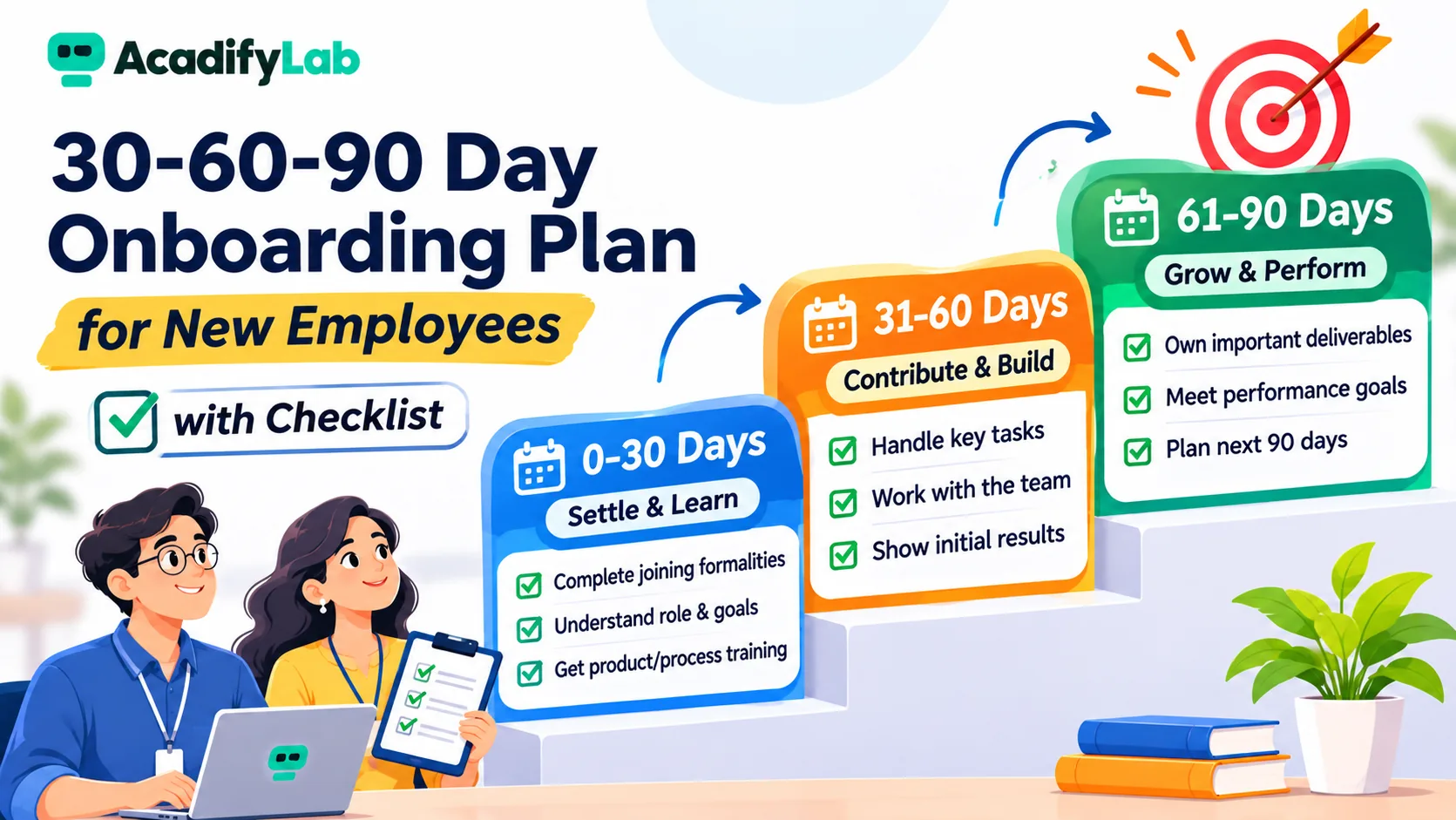
A 30-60-90 day onboarding plan splits a new employee’s first three months into three stages with clear goals: learn (first 30 days), contribute (days 31–60) and own (days 61–90). Each stage has named tasks, an owner for each task and a check-in at the end. Add a preboarding stage before day one so the new hire arrives to a working laptop, accounts and a first-week schedule.
This guide gives small HR teams and managers a plan they can copy, with a checklist for each stage and simple signs that onboarding is working.
Key takeaways
- Onboarding starts when the offer is accepted, not on day one.
- Give each stage one goal: learn, contribute, own.
- Every task needs an owner: HR, manager, buddy or IT.
- Hold a short, structured check-in at days 30, 60 and 90.
- Put compliance and role training in a trackable format so nothing is missed.
Before day one: preboarding
- HR: send the welcome email with joining date, time, location or video link, dress code and documents to bring.
- IT: set up laptop, email, chat and the tools the role needs.
- Manager: write the first-week schedule and draft 30-60-90 goals.
- Manager: choose a buddy, a peer who is not the manager.
- HR: share policies and any pre-reading, kept short.
Week one: settle in
- Welcome from the manager and a team introduction
- Workplace tour or a virtual walk-through of tools and channels
- Paperwork, payroll and benefits enrolment
- Mandatory training: code of conduct, POSH, data security and safety where relevant
- First one-to-one with the manager to walk through the 30-60-90 goals
- Lunch or coffee with the buddy
- One small, real task the person can finish by Friday
Days 1–30: learn
Goal: understand the company, the team, the role and the tools.
- Complete role-specific training modules
- Shadow colleagues on core tasks
- Meet key people in other teams
- Read key documents: processes, past reports, customer information
- Weekly one-to-one with the manager
Day 30 check-in: What’s clear? What’s confusing? Are tools and access working? Is the workload right?
Days 31–60: contribute
Goal: do the core work with support.
- Take on regular tasks independently, with review
- Complete advanced or product training
- Lead one small piece of work or a meeting
- Give feedback on onboarding: what helped and what was missing
Day 60 check-in: review the quality of work against expectations and agree on development areas.
Days 61–90: own
Goal: work independently and set goals for the next quarter.
- Own a recurring responsibility or project
- Suggest one improvement to a process
- Agree on performance goals for the next three to six months
- Confirm probation outcome where applicable
Day 90 check-in: a formal review of the first three months and the plan ahead.
Who owns what
| Stage | HR | Manager | Buddy | IT |
|---|---|---|---|---|
| Preboarding | Welcome email, documents | Schedule, goals | Intro message | Laptop, accounts |
| Week one | Paperwork, policy training | Welcome, first task | Lunch, tour | Tool help |
| Days 1–30 | Training tracking | Weekly 1:1, day-30 check-in | Answer questions | Access issues |
| Days 31–60 | Feedback survey | Day-60 review | Occasional check-in | – |
| Days 61–90 | Probation paperwork | Day-90 review, goals | – | – |
30-60-90 day onboarding plan examples by role
The stages stay the same; the goals change by role. Here is how the plan might look for three common roles.
Sales executive
- Day 30: knows the product range, pricing and ideal customer; has shadowed at least ten customer calls or meetings; can explain the sales process and CRM steps.
- Day 60: runs calls and demos with a senior colleague reviewing; keeps the CRM up to date without reminders.
- Day 90: manages their own pipeline and has an agreed target for the next quarter.
Customer support executive
- Day 30: completes product and ticketing tool training; answers common tickets using saved replies with review.
- Day 60: handles most ticket types independently; knows when and how to escalate.
- Day 90: meets the team’s quality standards and suggests one improvement to help articles or saved replies.
Team lead or manager
- Day 30: holds one-to-ones with every team member, understands current goals and problems, and meets key peers.
- Day 60: runs team rituals, makes first small process changes and agrees on priorities with their own manager.
- Day 90: presents a plan for the team for the next two quarters.
Onboarding remote and hybrid employees
Remote hires miss the informal learning that happens in an office, so the plan needs to make it deliberate:
- Ship the laptop early and run an IT check call before day one.
- Schedule short daily check-ins in week one, then reduce them.
- Give the buddy a clear role: a daily 15-minute call in the first two weeks.
- Record key training so new hires can rewatch it, and keep a single page of links to every tool and document.
- Book virtual introductions with people in other teams rather than leaving them to chance.
Questions for each check-in
- Day 30: What has been most useful so far? What is still unclear? Do you have everything you need to do your job?
- Day 60: Which tasks feel comfortable now, and which don’t? Where would more training help?
- Day 90: What are you proudest of? What should we change in onboarding for the next person? What do you want to achieve in the next six months?
How to know onboarding is working
- The new hire finished mandatory training on time.
- They delivered their first independent piece of work by day 45–60.
- Check-ins happened on schedule (a surprisingly common gap).
- Their onboarding feedback is positive and specific.
- They are still with you, and engaged, after six months.
Make it repeatable
The plan only helps if it is used every time. Put it in a shared checklist and keep training in one place so HR can see who has finished what. Download the free employee onboarding checklist to start, and read the onboarding LMS checklist for turning it into a repeatable training journey. If you train new hires online, see LMS for employee onboarding.
Common onboarding mistakes
- Nothing ready on day one. A new hire waiting two days for a laptop gets the wrong first impression.
- Information overload in week one. Spread policies and training over the first month.
- No clear goals. Without 30-60-90 goals, new hires guess what success looks like.
- Skipped check-ins. Busy managers cancel them first; put them in the calendar on day one.
- Onboarding ends after orientation. The hardest part, becoming productive, happens in months two and three.
Frequently asked questions
What is a 30-60-90 day onboarding plan?
It is a plan that sets goals and tasks for a new employee’s first 30, 60 and 90 days, usually learning in the first month, contributing in the second and working independently in the third, with check-ins at each stage.
Who creates the 30-60-90 day plan?
The manager usually drafts the role goals, and HR provides the template and company-wide tasks such as paperwork and policy training. The new employee should review it in week one and can add their own learning goals.
What should happen on an employee’s first day?
A personal welcome, introductions to the team and buddy, working access to tools, a short walk through the first-week schedule and goals, and ideally one small task they can start. Avoid filling the whole day with paperwork.
How long should employee onboarding last?
Basic orientation takes a week, but full onboarding usually runs for at least three months. The 30-60-90 day structure covers that period with clear stages and reviews.
Is a 30-60-90 day plan only for new employees?
No. The same structure works for internal transfers, promotions into management and people returning from long leave. Adjust the goals to what is new for them.
What training should be included in onboarding?
Mandatory policy and compliance training, tools and systems, role-specific skills and product or customer knowledge. Track completion so HR knows each new hire finished what is required.
What is the difference between orientation and onboarding?
Orientation is a one-time introduction, usually on the first day or week, covering the company, policies and paperwork. Onboarding is the longer process, often three months or more, of helping a new employee learn the role, build relationships and become fully productive.
Related articles