
On this page
- Before you start: list chapters and rate them
- Phase 1 (days 1–45): complete and consolidate
- Phase 2 (days 46–75): practise papers and fix weak topics
- Phase 3 (days 76–90): mocks and final revision
- Sample daily timetable (school day)
- Sample weekly plan
- Board exam revision timetable by subject
- Adjust the plan if you start late
- How parents and teachers can check progress
- Common revision mistakes
- Look after yourself during revision
- Printable checklist for the last week
- Frequently asked questions
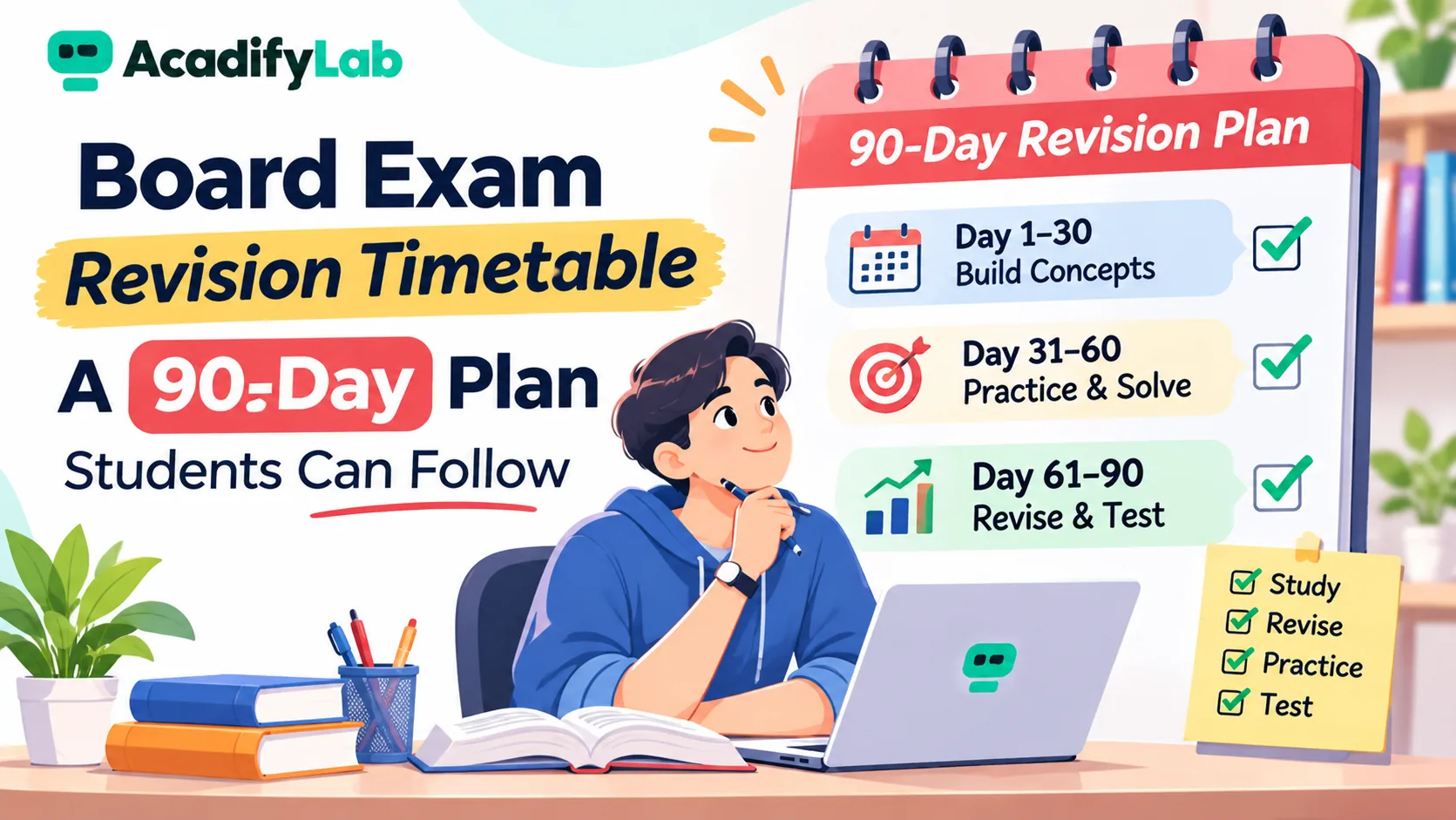
A good board exam revision timetable splits the last 90 days into three phases: finish and consolidate the syllabus (days 1–45), practise past papers and weak topics (days 46–75), and do full mock tests under exam conditions (days 76–90). Each day mixes one hard subject and one lighter one, includes at least one hour of written practice, and protects seven to eight hours of sleep.
This plan works for Class 10 and Class 12 students, and it is simple enough for parents and coaching teachers to check each week.
Key takeaways
- Plan backwards from the exam date sheet, not forwards from today.
- Rotate subjects daily; long single-subject days lead to forgetting the rest.
- Written practice beats re-reading. Solve questions every single day.
- Keep one buffer day each week for catch-up and rest.
- Track three numbers weekly: chapters revised, papers solved and mock test score.
Before you start: list chapters and rate them
Write every chapter of every subject on one sheet. Next to each, mark it green (confident), yellow (needs practice) or red (weak or not done). Count the red and yellow chapters. This list decides how you use phase 1, and it is the sheet a parent or teacher can tick off each week.
Phase 1 (days 1–45): complete and consolidate
- Cover red chapters first, then yellow.
- Two subjects a day: one heavy (maths, physics, accounts) and one lighter (languages, social science, biology theory).
- Make short notes for each chapter: formulas, definitions, diagrams and one page of key points. These are your revision notes for phase 3.
- End each chapter by solving the textbook exercises and five previous-year questions.
Phase 2 (days 46–75): practise papers and fix weak topics
- Solve one previous-year or sample paper every two days, alternating subjects.
- Check it against the marking scheme. Write down every mistake and the topic it came from.
- Spend the next day’s study session on those topics.
- Practise presentation: headings, labelled diagrams, step-wise working, and answers within the word limit.
Phase 3 (days 76–90): mocks and final revision
- Follow the actual exam date sheet order.
- Take a full three-hour mock at the same time of day as the real exam.
- Revise only from your own short notes and mistake list; avoid new books now.
- Reduce study hours slightly in the last two days before each paper and sleep well.
Sample daily timetable (school day)
| Time | Activity |
|---|---|
| 6:00–7:00 am | Revise yesterday’s notes and formulas (light subject or memory work) |
| School / coaching hours | Classes |
| 4:30–5:00 pm | Break, snack, short walk |
| 5:00–6:30 pm | Heavy subject: new chapter or problem practice |
| 6:30–6:45 pm | Break |
| 6:45–8:00 pm | Second subject: theory and written answers |
| 8:00–9:00 pm | Dinner and family time |
| 9:00–9:45 pm | Previous-year questions or mistake list |
| 10:00 pm | Sleep |
On holidays and after school ends for preparation leave, add a morning block of two to three hours for full-length papers.
Sample weekly plan
| Day | Heavy subject | Light subject |
|---|---|---|
| Mon | Maths | English |
| Tue | Science / Physics | Social science / second language |
| Wed | Maths | Biology / Chemistry theory |
| Thu | Science / Physics | English |
| Fri | Maths | Social science |
| Sat | Weekly mock test (one subject) | Check against marking scheme |
| Sun | Buffer: catch up on missed tasks | Rest |
Board exam revision timetable by subject
Not every subject should be revised the same way. Use these approaches inside your timetable slots.
Mathematics
- Practise every day, even for 45 minutes. Maths skills fade quickly without use.
- Keep a formula sheet and a list of question types you get wrong.
- Solve full papers within time; speed and step-wise presentation both carry marks.
Science
- Physics: numericals and derivations, with units and diagrams.
- Chemistry: equations, reactions and named processes. Write them out; reading is not enough.
- Biology: labelled diagrams and keyword-rich definitions. Practise drawing diagrams in two minutes or less.
Social science
- Make timelines for history, flow charts for processes, and practise map work weekly.
- Answer in points with headings; examiners scan for key terms.
Languages
- Practise one writing task (letter, notice, essay or article) every few days, using the prescribed format.
- Revise literature through character sketches, themes and short answers rather than re-reading whole chapters.
- Do one unseen passage a week to keep reading speed up.
Commerce subjects
- Accounts needs daily practice of formats: journal entries, ledgers and final accounts.
- For business studies and economics, learn definitions and diagrams precisely and practise case-based questions.
Adjust the plan if you start late
With 45–60 days left, merge phases 1 and 2: revise each chapter and solve its previous-year questions in the same session. Spend the last 15 days on full papers and your mistake list. With less than a month, focus on high-weightage chapters, past papers and the topics you can still improve; trying to cover everything at the last minute usually leads to covering nothing well.
How parents and teachers can check progress
Ask three questions every Sunday:
- How many chapters moved from red or yellow to green this week?
- How many papers or question sets were solved and checked?
- What was the weekly mock score, and which topics lost marks?
Teachers in coaching institutes can run the weekly mock as a test for the whole batch and share results with parents. Our guide to running online mock tests covers the workflow, and the free question paper generator helps you put together practice papers quickly. For building a fair paper, see how to make a question paper.
Common revision mistakes
- Only reading. Recognising a page is not the same as recalling it in the exam. Write answers.
- Skipping weak subjects. Students tend to revise what they enjoy. The red list keeps you honest.
- No breaks. Short breaks every 60–90 minutes improve concentration.
- Late-night studying before the exam. Sleep helps you remember what you revised.
- Too many reference books. One textbook, one question bank and past papers are enough.
Look after yourself during revision
A timetable only works if you can keep it up for three months. Protect the basics:
- Sleep: seven to eight hours, at roughly the same time every night.
- Movement: a 20–30 minute walk, game or stretch every day improves concentration.
- Phone breaks: keep your phone in another room during study blocks and check it only in breaks.
- Food and water: regular meals and water at your desk; avoid relying on late-night tea or energy drinks.
- Talk to someone: if stress builds up, tell a parent, teacher or friend. Feeling anxious before boards is common, and a short conversation often helps.
Printable checklist for the last week
- Admit card, ID and exam centre address checked and kept in one folder
- Pens, pencils, eraser, scale, geometry box and a transparent water bottle packed the night before
- Short notes and the mistake list revised for the next paper only
- Route and travel time to the centre planned, with 30 minutes to spare
- Sleep by 10 pm and a light breakfast on exam day
- Reading time used to choose the order in which to answer questions
Frequently asked questions
How many hours should I study for board exams?
On school days, three to four focused hours after school is realistic; during preparation leave, six to eight hours with breaks works for most students. Focused, written practice matters more than total hours.
When should I start revision for board exams?
Ideally about three months before the first paper, which gives time to finish the syllabus, solve past papers and take full mock tests. If you have less time, shorten phase 1 and focus on past papers and weak chapters.
How many sample papers should I solve?
Aim for at least five to ten full papers per major subject, checked against the marking scheme. Learning from each paper’s mistakes matters more than the total number solved.
Should I study one subject per day?
It is better to study two subjects a day, one heavy and one lighter. Rotating subjects keeps all of them fresh and reduces fatigue.
What if I fall behind my revision timetable?
Use the weekly buffer day to catch up, and if you fall behind by more than a few days, cut lower-weightage chapters rather than squeezing in longer hours. Keep sleep and daily written practice fixed.
How can I make a revision timetable?
List all chapters, rate them by confidence, count the days until your first paper, split them into three phases, and assign two subjects per day with one buffer day a week. Review and adjust the plan every Sunday.
Related articles