On this page
- 1. Drafting quiz questions
- 2. Lesson summaries
- 3. Re-engagement nudges
- 4. Content suggestions for instructors
- 5. Learner support triage
- 6. Administrative assistance
- 7. Learning-path recommendations
- 8. Analytics interpretation
- Responsible-use checklist
- AcadifyLab context
- Action checklist
- Related AcadifyLab resources
- Next step
- Frequently asked questions
- Conclusion
- Further reading
Responsible AI in an LMS goes beyond a chatbot. Useful applications can support content preparation, quiz generation, summaries, learner nudges, administrative workflows and analysis, but they should be designed with human oversight, privacy boundaries and clear educational purpose.
The practical approach is to start from the learning and operating problem, define the minimum workflow that solves it, and then use technology to make that workflow consistent. This guide focuses on decisions that can be tested in a real LMS rather than on feature-count marketing.
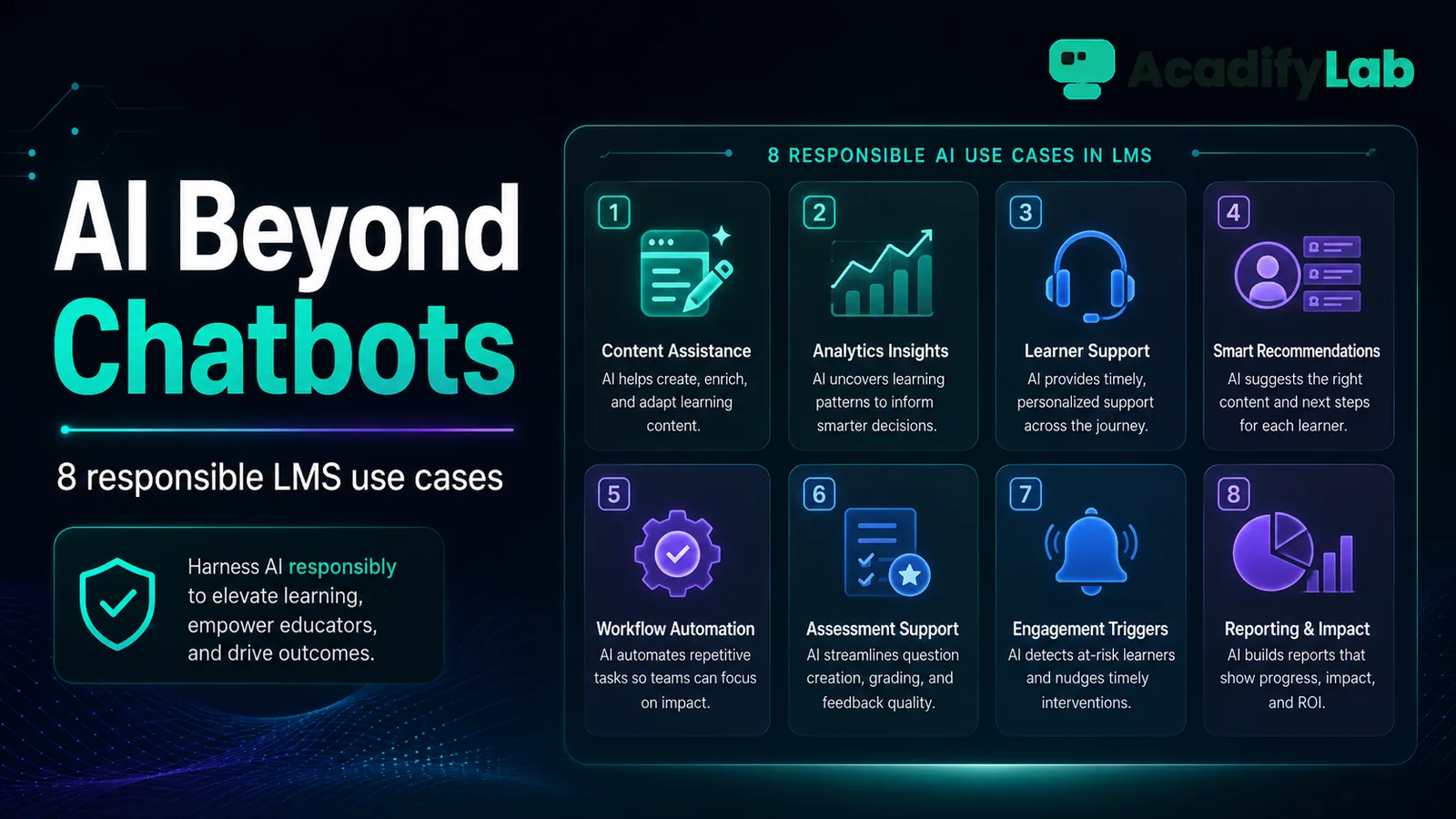
1. Drafting quiz questions
AI can help instructors create first-pass questions from approved material. Faculty should review accuracy, difficulty and alignment before publishing.
2. Lesson summaries
AI-generated summaries can make revision easier, but should be grounded in course material and checked where precision matters.
3. Re-engagement nudges
Systems can identify inactive learners and draft reminders, while program owners control tone, frequency and escalation.
4. Content suggestions for instructors
AI can propose examples, practice prompts or alternative explanations, reducing preparation time without removing instructor judgment.
5. Learner support triage
Routine questions can be handled automatically while complex, sensitive or high-stakes questions are escalated to a human.
6. Administrative assistance
AI can help summarise feedback, categorize support requests or draft routine communications.
7. Learning-path recommendations
Recommendations can be useful when based on relevant learner data, but organisations should avoid opaque decisions that materially affect learners without review.
8. Analytics interpretation
AI can help surface patterns in engagement or assessment data, but the interpretation should not be treated as proof of motivation, ability or job performance.
Responsible-use checklist
Use approved data, minimise personal information, disclose material AI use where appropriate, review outputs, provide escalation paths and keep humans accountable for consequential decisions.
AcadifyLab context
AcadifyLab lists an AI learning assistant, auto-generated quizzes and summaries, and smart re-engagement nudges. Its existing blog already covers doubt-solving, so this article focuses on broader responsible-use patterns.
Action checklist
- Review and document: 1. drafting quiz questions.
- Review and document: 2. lesson summaries.
- Review and document: 3. re-engagement nudges.
- Review and document: 4. content suggestions for instructors.
- Review and document: 5. learner support triage.
- Review and document: 6. administrative assistance.
Use the checklist with a real course, batch or training program. Record any exception that still requires a spreadsheet, manual message or separate tool; those exceptions are often the most useful questions to raise during a trial or vendor demo.
Related AcadifyLab resources
Explore the AcadifyLab features overview and the relevant solution page for your use case.
Enterprise LMS for training companies
Next step
If you need to validate a multi-step workflow, a live product walkthrough is the fastest way to test requirements against the platform before committing.
Frequently asked questions
How is AI used in an LMS?
AI can assist with learner support, content preparation, quizzes, summaries, recommendations, reminders, administration and analysis depending on the platform.
Should AI-generated quizzes be published automatically?
Human review is advisable to check accuracy, difficulty, bias and alignment with the course.
Can AI make decisions about learners?
Organisations should be cautious with consequential decisions and maintain appropriate human oversight.
What data should an AI LMS use?
Use only data that is relevant and permitted for the learning purpose, with appropriate privacy and security controls.
Does AI replace instructors?
AI can automate repetitive support and drafting, but educators remain important for judgment, pedagogy, feedback and accountability.
Conclusion
AI in LMS is ultimately a workflow decision, not a checklist contest. Define what learners and administrators need to accomplish, keep the process simple enough to operate consistently, and use the LMS to make that process visible and repeatable. For training enterprises, that approach is more durable than choosing technology around whichever feature happens to be trending.
Further reading
- UNESCO: Guidance for generative AI in education and research
- Google Search guidance on generative AI content
Related articles