On this page
- Step 1: Define who will learn
- Step 2: Define the learning model
- Step 3: Map the admin workflow
- Step 4: Evaluate learner experience
- Step 5: Check branding and ownership
- Step 6: Review analytics and reporting
- Step 7: Review integrations and AI carefully
- Step 8: Compare total cost
- Step 9: Run a realistic trial or demo
- AcadifyLab context
- Action checklist
- Related AcadifyLab resources
- Next step
- Frequently asked questions
- Conclusion
- Further reading
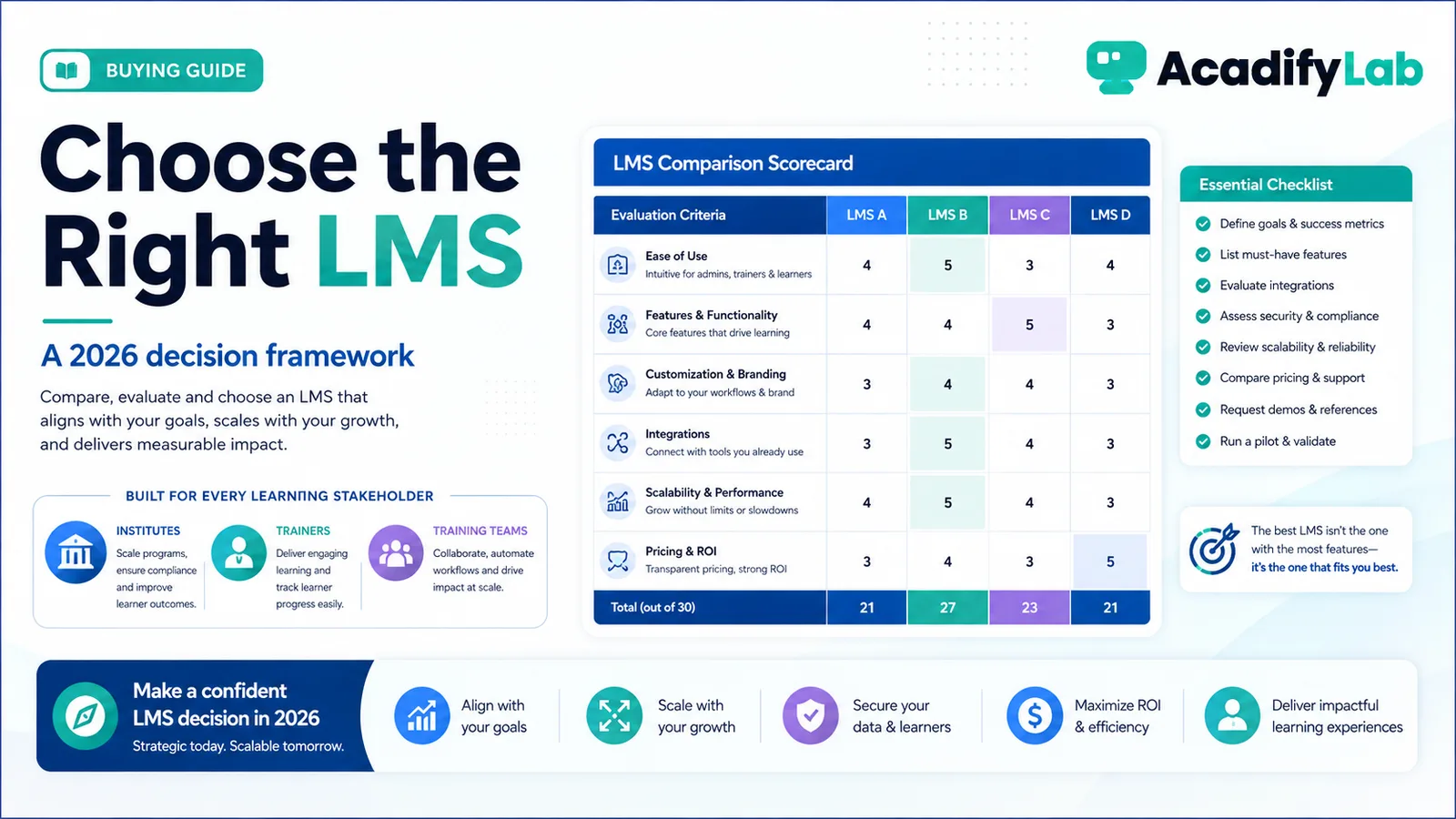
The best LMS is the one that fits your audience, learning model, operating workflow and growth plan. In 2026, buyers should evaluate learner experience, branding, mobile access, live and asynchronous delivery, assessments, analytics, commerce, AI, integrations, migration, support and total cost together.
The practical approach is to start from the learning and operating problem, define the minimum workflow that solves it, and then use technology to make that workflow consistent. This guide focuses on decisions that can be tested in a real LMS rather than on feature-count marketing.
Step 1: Define who will learn
Start with coaching students, paid course customers, employees, partners, customers or a combination. Audience determines access, commerce, reporting and branding requirements.
Step 2: Define the learning model
List whether you need recorded courses, live classes, classroom support, cohorts, assessments, certificates, community or compliance workflows.
Step 3: Map the admin workflow
Document enrolment, batch/group creation, scheduling, communications, payments, reporting and support. The LMS should simplify the operating model rather than create parallel spreadsheets.
Step 4: Evaluate learner experience
Test web and mobile journeys. Ask a real learner to find a course, join a class, complete an assessment, download a resource and understand progress.
Step 5: Check branding and ownership
If brand control matters, verify domain, app identity, learner-facing communications, data access and migration rights.
Step 6: Review analytics and reporting
Choose reports based on decisions you need to make. Avoid buying “advanced analytics” without defining who will use them.
Step 7: Review integrations and AI carefully
Check whether integrations match tools you actually use. For AI, evaluate educational purpose, data handling, human oversight and output quality rather than buying on the label alone.
Step 8: Compare total cost
Include subscription, users, storage, apps, implementation, migration, support, messaging, payment charges and revenue sharing.
Step 9: Run a realistic trial or demo
Use your own sample course and workflow. A scripted sales demo is useful, but hands-on testing reveals operational friction.
AcadifyLab context
AcadifyLab offers a white-label LMS for coaching institutes, trainers and training enterprises with branded apps, live classes, assessments, analytics, payments, community, multi-branch features and AI capabilities. Its pricing page states a 7-day free trial, no setup fee and zero revenue sharing. Verify the current plan inclusions before purchasing.
Action checklist
- Review and document: step 1: define who will learn.
- Review and document: step 2: define the learning model.
- Review and document: step 3: map the admin workflow.
- Review and document: step 4: evaluate learner experience.
- Review and document: step 5: check branding and ownership.
- Review and document: step 6: review analytics and reporting.
Use the checklist with a real course, batch or training program. Record any exception that still requires a spreadsheet, manual message or separate tool; those exceptions are often the most useful questions to raise during a trial or vendor demo.
Related AcadifyLab resources
Explore the AcadifyLab features overview and the relevant solution page for your use case.
White-label course platform for trainers
Enterprise LMS for training companies
Next step
If you need to validate a multi-step workflow, a live product walkthrough is the fastest way to test requirements against the platform before committing.
Frequently asked questions
What is the first step in choosing an LMS?
Define your audience, learning goals and operating workflows before comparing platforms.
Which LMS features matter most?
The important features are the ones required by your learning model: content delivery, live learning, assessments, mobile access, analytics, commerce, branding or compliance as relevant.
Should you choose an LMS based on price?
Price matters, but compare total cost and workflow fit rather than subscription fee alone.
How important is a free trial?
A trial helps you validate learner and admin workflows using realistic content before committing.
What should Indian coaching institutes check specifically?
Consider payment methods, mobile experience, batch and test workflows, communication, support and the way your learners actually access classes and content.
Conclusion
How to Choose an LMS in 2026 is ultimately a workflow decision, not a checklist contest. Define what learners and administrators need to accomplish, keep the process simple enough to operate consistently, and use the LMS to make that process visible and repeatable. For all three audiences, that approach is more durable than choosing technology around whichever feature happens to be trending.
Further reading
Related articles