On this page
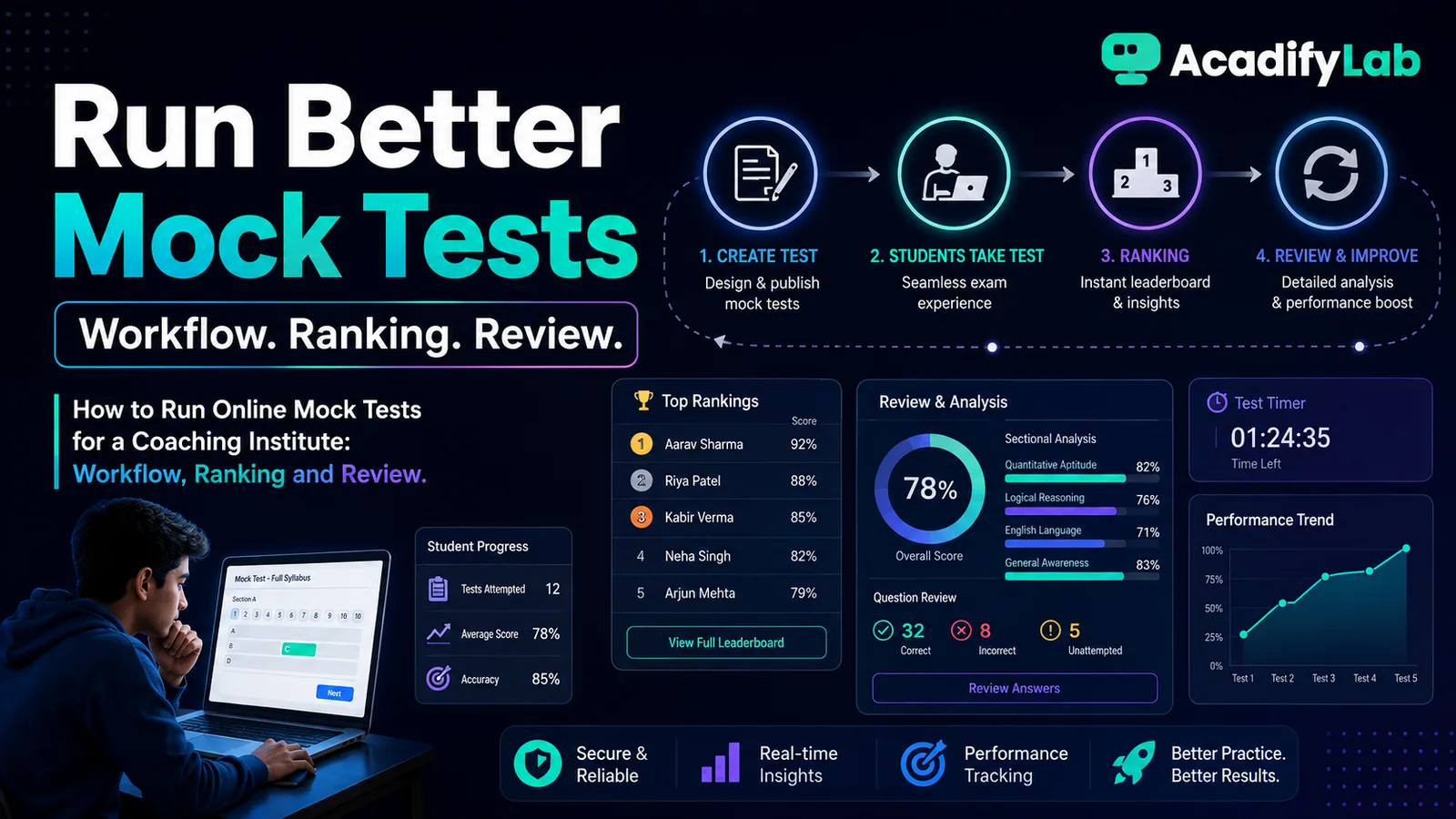
A strong online mock-test workflow mirrors the target exam closely enough to build exam readiness, while also producing useful feedback after the attempt. The process should cover blueprint, scheduling, attempt rules, grading, ranking and remediation.
The practical approach is to start from the learning and operating problem, define the minimum workflow that solves it, and then use technology to make that workflow consistent. This guide focuses on decisions that can be tested in a real LMS rather than on feature-count marketing.
Build the paper from a blueprint
Map syllabus coverage, marks, difficulty and question types before choosing individual questions.
Configure realistic attempt conditions
Set the attempt window, duration, navigation rules and marking scheme to resemble the intended exam where appropriate.
Communicate before the test
Tell learners the syllabus, start time, allowed devices/materials, submission rules and what happens if connectivity fails.
Separate score, rank and learning feedback
Rank can provide competitive context, but topic-level feedback tells learners what to improve. Use both only when they serve the program goal.
Run the review cycle
After results, identify common errors, hold a focused review, assign corrective practice and schedule the next mock after learners have had time to improve.
Watch for test-quality problems
If most learners miss one question, investigate whether the concept is weak or the question is ambiguous. Analytics should improve the test bank as well as the learner.
AcadifyLab context
AcadifyLab lists exams, mock series, automatic grading/ranking on its coaching-institute page, plus student analytics. Institutes can use these tools to operationalize a repeatable mock-test cycle.
Action checklist
- Review and document: build the paper from a blueprint.
- Review and document: configure realistic attempt conditions.
- Review and document: communicate before the test.
- Review and document: separate score, rank and learning feedback.
- Review and document: run the review cycle.
- Review and document: watch for test-quality problems.
Use the checklist with a real course, batch or training program. Record any exception that still requires a spreadsheet, manual message or separate tool; those exceptions are often the most useful questions to raise during a trial or vendor demo.
Related AcadifyLab resources
Explore the AcadifyLab features overview and the relevant solution page for your use case.
Next step
If this workflow matches what you are trying to build, test it with your own sample course, batch or training program rather than relying on screenshots alone.
Frequently asked questions
What is an online mock test?
It is a timed practice assessment designed to simulate important aspects of a target examination.
Should mock tests include rankings?
Only when ranking supports the learning goal. Pair rank with topic-level feedback so learners know what to improve.
How often should mock tests be scheduled?
Allow enough time for review and remediation between attempts; frequency should match the stage of preparation.
What should happen after a mock test?
Review errors, identify weak topics, assign targeted practice and then retest after improvement work.
Can analytics improve question quality?
Yes. Unusual response patterns can reveal ambiguous, overly easy or overly difficult questions that deserve review.
Conclusion
How to Run Online Mock Tests for a Coaching Institute is ultimately a workflow decision, not a checklist contest. Define what learners and administrators need to accomplish, keep the process simple enough to operate consistently, and use the LMS to make that process visible and repeatable. For coaching institutes, that approach is more durable than choosing technology around whichever feature happens to be trending.
Related articles