On this page
- Define completion precisely
- Separate participation from competency
- Plan expiry and renewal
- Keep an auditable record
- Control who can issue or change records
- Make reports useful to managers
- AcadifyLab context
- Action checklist
- Related AcadifyLab resources
- Next step
- Frequently asked questions
- Conclusion
- Further reading
Certificates are useful only when the rules behind them are clear. Enterprises should define what constitutes completion, who is authorized to issue a credential, how long it remains valid, and what evidence must be retained for reporting or audit.
The practical approach is to start from the learning and operating problem, define the minimum workflow that solves it, and then use technology to make that workflow consistent. This guide focuses on decisions that can be tested in a real LMS rather than on feature-count marketing.
Define completion precisely
Completion can mean viewing required content, attending a session, passing an assessment, submitting evidence or a combination. Document the rule before configuring automation.
Separate participation from competency
A participation certificate says someone attended; a competency or role certificate should require stronger evidence. Use labels that match what was actually demonstrated.
Plan expiry and renewal
Some training is one-time; other training must be refreshed. Define validity periods, reminder logic and what happens when certification expires.
Keep an auditable record
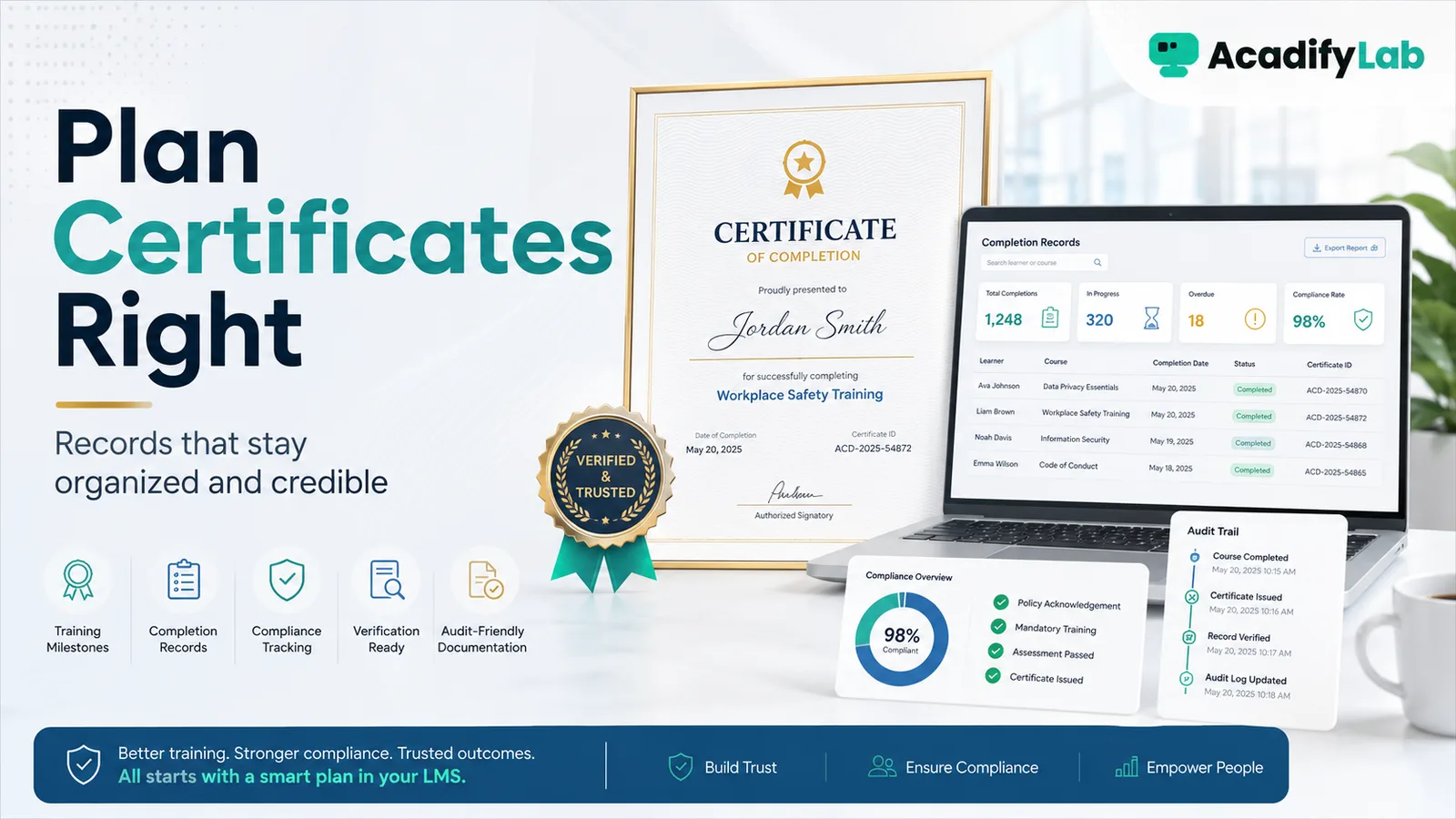
Store learner identity, course/version, completion date, assessment result where applicable and certificate status. Avoid relying only on a downloadable PDF.
Control who can issue or change records
Role-based access is important because certification data can affect compliance and operational eligibility.
Make reports useful to managers
Managers usually need exceptions: who is overdue, whose certification is expiring and which roles are not compliant.
AcadifyLab context
AcadifyLab lists auto-issued branded certificates and, for enterprises, internal certification, compliance training, role-based access and export-ready reporting. Verify retention and audit requirements specific to your organisation.
Action checklist
- Review and document: define completion precisely.
- Review and document: separate participation from competency.
- Review and document: plan expiry and renewal.
- Review and document: keep an auditable record.
- Review and document: control who can issue or change records.
- Review and document: make reports useful to managers.
Use the checklist with a real course, batch or training program. Record any exception that still requires a spreadsheet, manual message or separate tool; those exceptions are often the most useful questions to raise during a trial or vendor demo.
Related AcadifyLab resources
Explore the AcadifyLab features overview and the relevant solution page for your use case.
Enterprise LMS for training companies
Next step
If you need to validate a multi-step workflow, a live product walkthrough is the fastest way to test requirements against the platform before committing.
Frequently asked questions
What information should a training certificate contain?
Typically learner identity, program name, completion or issue date and issuer details, plus any credential identifier if your organisation uses one.
Is a certificate the same as proof of competency?
Not necessarily. The meaning depends on the completion and assessment rules behind the certificate.
Should certificates expire?
Only when the underlying training or policy requires renewal.
What is a completion record?
It is the system record showing that a learner met the defined completion conditions, even if a PDF certificate is also issued.
Why is role-based access important for certification?
It limits who can issue, edit or view records that may affect compliance or operational eligibility.
Conclusion
Training Certificates and Completion Records is ultimately a workflow decision, not a checklist contest. Define what learners and administrators need to accomplish, keep the process simple enough to operate consistently, and use the LMS to make that process visible and repeatable. For training enterprises, that approach is more durable than choosing technology around whichever feature happens to be trending.
Further reading
Related articles