On this page
- What is microlearning?
- Why training teams use microlearning
- When microlearning works
- When microlearning doesn’t work
- How to design a five-minute micro-lesson
- Microlearning examples
- Sequencing micro-lessons into a programme
- How to measure microlearning
- Microlearning vs traditional courses
- Getting started: a 30-day microlearning pilot
- Common microlearning mistakes
- Delivering microlearning to distributed teams
- Frequently asked questions
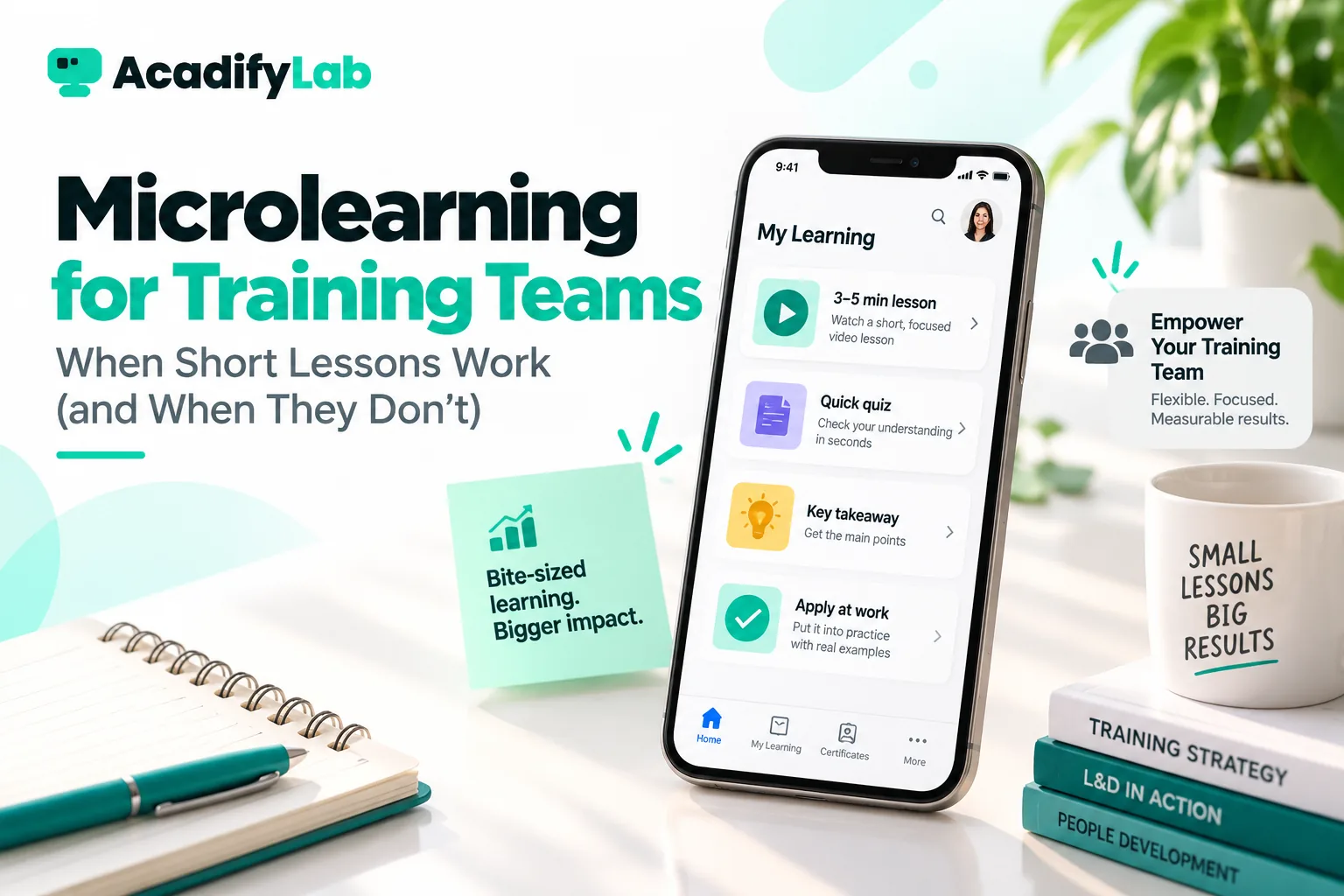
Microlearning delivers training in short, focused units, usually between two and ten minutes, that each cover a single objective. It works well for refreshers, product updates, reinforcement after longer training, quick how-to guidance and compliance reminders. It works poorly as the only method for complex skills, deep conceptual understanding or behaviour change that needs practice and feedback. Used well, microlearning is a powerful supplement to structured training, not a replacement for it.
This guide explains what microlearning is, where it helps and where it doesn’t, how to design an effective five-minute lesson, how to sequence lessons into a programme, and how to measure whether it works.
Key takeaways
- Microlearning means short, single-objective learning units, not long courses cut into random pieces.
- It is strongest for reinforcement, refreshers, updates and performance support at the moment of need.
- Complex skills still need structured learning, practice and feedback; microlearning can reinforce them afterwards.
- Every micro-lesson needs one objective, one core idea and one action or check.
- Measure application on the job, not just completion rates.
What is microlearning?
Microlearning is an approach to training that breaks learning into small, self-contained units. Each unit focuses on one objective that learners can complete in a few minutes, often on a phone. Formats include short videos, interactive cards, quizzes, infographics, scenarios, checklists, audio clips and quick simulations.
Three characteristics define good microlearning:
- Short: typically two to ten minutes.
- Focused: one objective, one idea, one task.
- Self-contained: makes sense on its own, even if it belongs to a series.
Microlearning is not simply a long course chopped into short videos. If a lesson only makes sense after watching the previous four, it is a segmented course, which can be fine, but it does not deliver the flexibility of true microlearning.
The idea draws on well-established learning research. People forget much of what they learn unless they revisit it, and short, spaced reviews with recall practice help memory far more than rereading or a single long session. Microlearning makes that kind of spacing practical in a busy workplace, which is why it pairs so naturally with longer training rather than competing with it.
Why training teams use microlearning
- Fits busy schedules: employees can learn in the gaps of a working day rather than blocking hours.
- Mobile-friendly: short units suit phones, which matters for frontline, field and shift workers without desks.
- Supports spaced repetition: short reviews spread over time help people retain information better than a single long session.
- Quick to update: when a product or process changes, you update one short unit instead of re-recording an entire course.
- Just-in-time support: employees can look up a three-minute how-to exactly when they need it.
When microlearning works
1. Reinforcing longer training
After an onboarding programme or workshop, a series of short quizzes and scenario questions over the following weeks helps people remember and apply what they learned. This is one of the most effective uses of microlearning.
2. Product and process updates
A new feature, price change, policy update or revised procedure can be explained in a short video or card series that reaches every employee within days.
3. Compliance refreshers and nudges
Short reminders on data protection, safety rules or code-of-conduct scenarios keep key points fresh between full compliance courses. Our page on compliance training covers the full approach.
4. Performance support at the moment of need
Short how-to guides, such as “how to process a return” or “how to log a site incident”, are most useful when employees can find them in seconds while doing the task.
5. Building knowledge foundations
Vocabulary, product facts, terminology and simple rules can be learned effectively through short units with frequent recall practice.
6. Sales and customer-facing teams
Objection-handling tips, competitor comparisons and talk tracks delivered in short bursts suit people who are often on the move and need quick refreshers before calls.
When microlearning doesn’t work
1. Complex skills that need practice
Leading difficult conversations, diagnosing complex technical faults or performing a surgical procedure cannot be learned through five-minute videos alone. These skills need structured instruction, guided practice, feedback and often coaching. Microlearning can support them before and after, but not replace them.
2. Deep conceptual understanding
Topics that build on interconnected ideas, such as financial modelling or system architecture, need a coherent sequence and time to connect concepts. Fragmenting them too much can leave learners with isolated facts and no understanding of how they fit together.
3. Behaviour and culture change
Changing how people lead, collaborate or make decisions depends on reflection, discussion, practice and reinforcement from managers. Microlearning nudges help, but they cannot carry the whole effort.
4. When the real problem isn’t training
If people know what to do but lack time, tools or clear processes, more content, short or long, won’t fix it.
How to design a five-minute micro-lesson
Use this simple structure for each unit:
- One objective (decide before you write): “After this lesson, the learner can identify the three signs of a phishing email.”
- Hook (15–30 seconds): a realistic situation or question: “You receive an urgent email from your ‘CEO’ asking for gift cards. What do you do?”
- Core content (2–3 minutes): the essential explanation with one clear example. Cut everything that isn’t needed for the objective.
- Practice or check (1–2 minutes): two or three questions or a quick scenario decision with feedback.
- Takeaway (15 seconds): one sentence or a checklist the learner can apply immediately.
Design tips
- Write for the phone screen first: large text, short sentences, vertical-friendly visuals.
- Use real workplace examples and the language your employees actually use.
- Add captions to videos so they can be watched without sound.
- Make every unit findable with a clear title, such as “How to handle a refund request” rather than “Module 3.2”.
- Keep production simple. A clear smartphone video by a subject expert often works better than an expensive animation.
Microlearning examples
| Need | Micro-lesson example | Format |
|---|---|---|
| Security awareness | Spot the phishing email: three examples, choose which is fake | Interactive quiz |
| Product launch | What’s new in version 5: three features customers will ask about | Two-minute video plus quiz |
| Customer service | Responding to an angry customer in three steps | Scenario with branching choices |
| Safety | Ladder check before you climb | Checklist card plus one-minute video |
| Onboarding reinforcement | Weekly five-question recap of onboarding topics | Spaced quiz |
| Sales | Handling the “it’s too expensive” objection | Audio clip plus practice prompt |
| Software use | How to raise a purchase request in the ERP | Screen recording with captions |
Sequencing micro-lessons into a programme
Individual micro-lessons work best as part of a planned sequence. Here is an example: reinforcing a two-day customer service workshop over four weeks.
- Week 1: three short recap quizzes on the service model taught in the workshop, delivered on days 2, 4 and 6.
- Week 2: two scenario lessons on handling complaints, plus a manager check-in conversation.
- Week 3: one video example of an excellent call and one practice prompt to try on a real call.
- Week 4: a final mixed scenario quiz and a short reflection: “What have you changed since the workshop?”
This pattern, structured learning followed by spaced micro-reinforcement and manager involvement, is usually far more effective than either a single workshop or a library of unconnected short videos. It also fits well inside an employee onboarding journey; see our employee onboarding LMS checklist for how to structure the first weeks.
How to measure microlearning
- Completion and engagement: who started and finished each unit, and how quickly. Useful, but not proof of learning.
- Quiz performance over time: are scores on repeated concepts improving across spaced checks?
- Application on the job: manager observations, quality audits, mystery shopping or system data showing the behaviour is happening.
- Business indicators: fewer errors, faster task completion, fewer support tickets, better customer satisfaction, depending on the goal.
- Learner feedback: was the unit relevant, clear and useful at the moment it arrived?
Our guide to learning analytics for training enterprises explains how to build a measurement approach that goes beyond completion.
Microlearning vs traditional courses
| Microlearning | Traditional course or workshop | |
|---|---|---|
| Length per unit | 2–10 minutes | 30 minutes to several days |
| Scope | One objective | Several connected objectives |
| Best for | Reinforcement, updates, quick how-tos, knowledge | Complex skills, deep understanding, practice with feedback |
| Timing | Spread over days or weeks, or on demand | Scheduled blocks |
| Device | Often phone-first | Laptop, classroom or live online session |
| Update effort | Low: change one unit | Higher: revise and re-run the course |
The strongest programmes combine both: a structured course or live workshop to build the skill, then microlearning to keep it fresh and support it on the job.
Getting started: a 30-day microlearning pilot
- Week 1, choose the target: pick one clear need, such as reinforcing a recent product training for the sales team, and define what success looks like on the job.
- Week 1, write objectives: list eight to twelve single objectives that matter most.
- Week 2, build simply: create short units using smartphone videos, slides with voice-over or quiz questions. Test two with a few learners and revise.
- Weeks 2–4, deliver on a schedule: release two or three units a week with reminders, and brief managers to discuss them in team meetings.
- Week 4, measure: review completion, quiz trends, manager observations and learner feedback. Decide what to keep, change or scale.
A small pilot shows quickly whether microlearning suits your audience and topics, and gives you real examples to show stakeholders before you invest more.
Common microlearning mistakes
- Chopping a long course into pieces without redesigning it, so each piece depends on the others.
- Too much content per unit. Squeezing twenty minutes of content into five minutes of fast talking defeats the purpose.
- No practice. Watching a short video is still passive. Add a question, decision or task.
- Random delivery. Units pushed without a plan or sequence feel like noise and get ignored.
- Using microlearning for everything. Complex skills still need deeper learning experiences.
Delivering microlearning to distributed teams
Microlearning depends on easy access. Employees should be able to open a lesson from a notification, finish it on a phone in a few minutes and pick up where they left off. A learning platform with a good mobile app, assignment by role, reminders, quizzes with instant feedback and reports by team makes this practical. See our employee training software page and the mobile app feature for how AcadifyLab supports learning on the go.
Frequently asked questions
What is microlearning?
Microlearning is a training approach that delivers content in short, focused units, usually two to ten minutes, each covering one objective. Units can be videos, quizzes, interactive cards, scenarios or checklists, and are often designed for mobile. It is especially useful for reinforcement, refreshers, updates and quick how-to support.
What are examples of microlearning?
Examples include a two-minute video on a new product feature, a five-question quiz reviewing onboarding topics, a phishing-spotting challenge, a branching scenario on handling an angry customer, a safety checklist card and a short screen recording showing how to complete a task in company software.
Is microlearning effective?
Microlearning is effective for reinforcement, refreshers, simple knowledge and performance support, particularly when combined with spaced repetition and practice questions. It is less effective on its own for complex skills, deep understanding or behaviour change, which need structured learning, practice and feedback. It works best as part of a blended approach.
How long should a microlearning module be?
Most microlearning modules run between two and ten minutes, with around five minutes a common target. Length matters less than focus: each module should cover one objective completely. If content needs more time, split it into separate, self-contained objectives rather than speeding up the delivery.
What is the difference between microlearning and e-learning?
E-learning is any learning delivered digitally, including long courses and full programmes. Microlearning is one design approach within e-learning, focused on very short, single-objective units. A complete e-learning programme might include longer modules for core skills plus microlearning units for reinforcement and quick reference.
Related articles