On this page
- What are soft skills?
- Why soft skills training matters
- 30 soft skills training topics
- Soft skills topics for students and freshers
- How to choose the right topics
- How to deliver soft skills training that sticks
- A sample eight-week soft skills programme
- Common mistakes in soft skills training
- How to assess soft skills
- Running soft skills programmes at scale
- Frequently asked questions
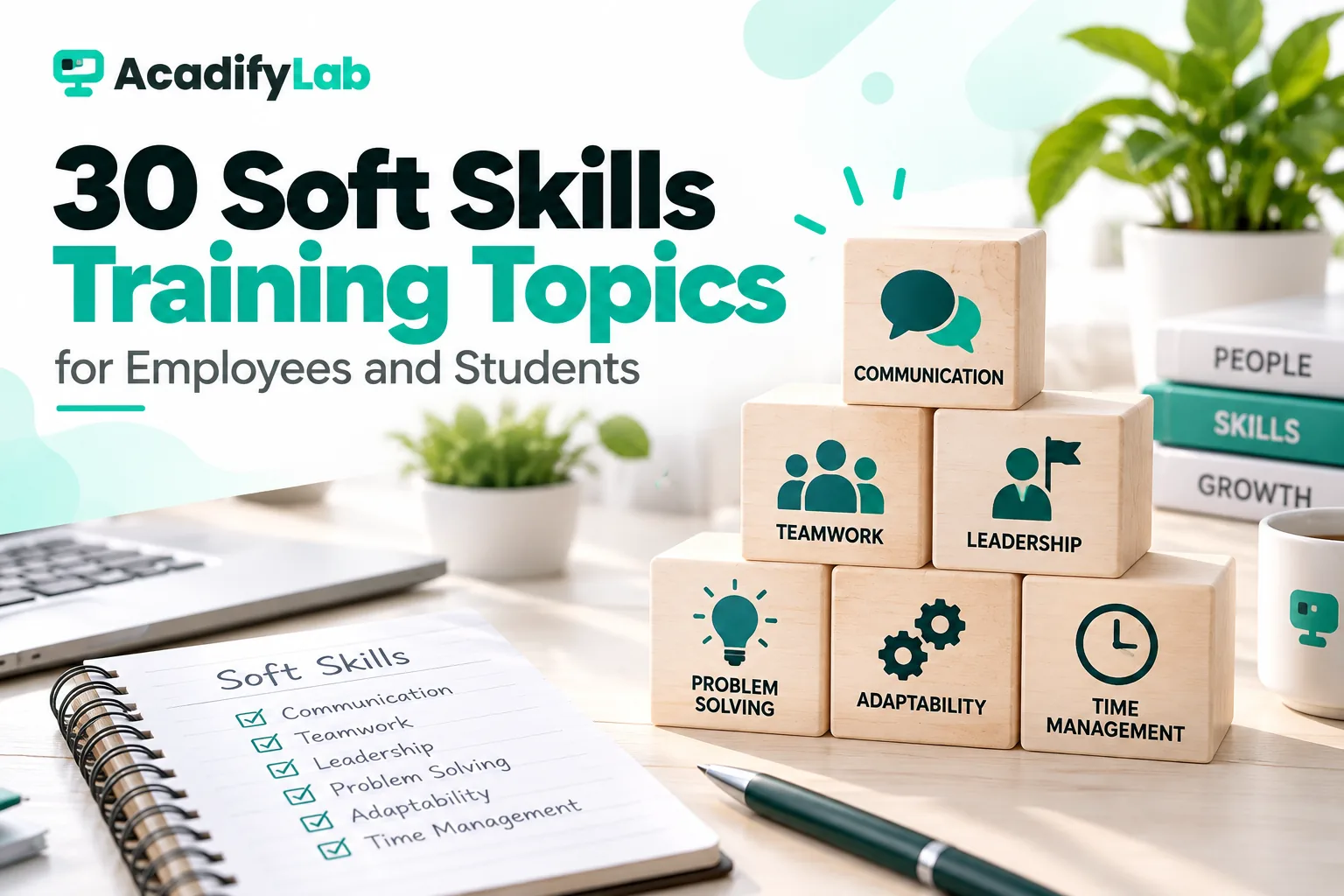
The most valuable soft skills training topics cover communication, teamwork, leadership, problem-solving, customer handling and self-management. Below are 30 topics in those six groups, each with a practical activity you can use in a workshop or online session. After the list you’ll find how to choose topics for your audience, deliver them so behaviour actually changes, and assess skills that don’t fit neatly into a multiple-choice test.
The list works for corporate training teams, independent soft skills trainers, colleges running placement readiness programmes and coaching institutes adding personality development to their courses.
Key takeaways
- Soft skills are learned through practice and feedback, not lectures. Every topic needs an activity.
- Choose topics from real performance gaps, such as customer complaints, team friction or interview results, not from a generic list.
- Short, spaced sessions with practice between them change behaviour more than one long workshop.
- Assess soft skills with role-plays, observation rubrics and feedback from managers or peers.
- Blend formats: online modules for concepts, live sessions for practice, on-the-job tasks for application.
What are soft skills?
Soft skills are the interpersonal, communication and self-management abilities that determine how people work with others and handle situations. Unlike technical skills, they apply across roles and industries. Employers consistently rank skills such as communication, teamwork and problem-solving among the most important qualities in candidates, which is why soft skills training is common in companies, colleges and skill development programmes alike.
Why soft skills training matters
Technical skills get people hired, but soft skills shape how well they perform once they are in the role. A skilled engineer who cannot explain a problem to a client, a knowledgeable salesperson who doesn’t listen, or a new manager who avoids difficult conversations can all hold back a team’s results. Soft skills also affect retention: people are more likely to stay in teams where communication is clear, conflict is handled fairly and managers coach rather than command.
For students, soft skills often decide placement outcomes. In interviews and group discussions, candidates with similar academic records are frequently separated by how clearly they communicate, how they work with others and how they handle pressure. That is why many colleges, skill development centres and coaching institutes now include soft skills modules alongside technical or exam preparation.
Unlike knowledge, these skills improve only with deliberate practice and feedback. Well-designed training gives people a safe place to practise before the stakes are real.
30 soft skills training topics
Communication
- Active listening. Activity: pairs take turns describing a problem; the listener must summarise it accurately before responding.
- Clear and concise speaking. Activity: explain a complex process in 60 seconds, then cut it to 30.
- Professional email and business writing. Activity: rewrite a confusing real-world email to be clear, polite and action-focused.
- Presentation skills. Activity: three-minute presentations with structured peer feedback on structure, voice and visuals.
- Giving and receiving feedback. Activity: practise a feedback model such as situation–behaviour–impact on realistic scenarios.
- Communicating across cultures and languages. Activity: discuss misunderstandings caused by different communication styles and agree on team norms.
Teamwork and collaboration
- Working effectively in teams. Activity: a timed group challenge followed by a debrief on roles and communication.
- Conflict resolution. Activity: role-play a common workplace disagreement using an interest-based approach.
- Collaboration in remote and hybrid teams. Activity: design a team charter for meetings, response times and tools.
- Building trust. Activity: reflect on behaviours that build and break trust, then commit to one change.
- Running effective meetings. Activity: redesign a real meeting’s agenda, roles and outcomes.
Leadership and influence
- Leadership basics for first-time managers. Activity: case discussion of a new manager’s first month.
- Delegation. Activity: list current tasks and decide what to delegate, to whom and with what support.
- Coaching conversations. Activity: practise a simple coaching model such as GROW (goal, reality, options, way forward) in trios.
- Influencing without authority. Activity: plan how to win support for an idea from stakeholders with different priorities.
- Motivating a team. Activity: identify what motivates each team member and tailor recognition.
Problem-solving and thinking
- Critical thinking. Activity: evaluate claims in a short article for evidence and assumptions.
- Structured problem-solving. Activity: apply root-cause analysis such as “five whys” to a real recurring problem.
- Decision-making. Activity: use a decision matrix to compare options against agreed criteria.
- Creativity and idea generation. Activity: timed brainstorming with “no judgement” rules, then selection.
- Adaptability and handling change. Activity: map reactions to a recent change and plan supportive responses.
Customer and client handling
- Customer service excellence. Activity: mystery-shopper style role-plays with a service checklist.
- Handling complaints and difficult customers. Activity: practise a calm de-escalation sequence on escalating scenarios.
- Telephone and video call etiquette. Activity: record and review practice calls against a rubric.
- Negotiation skills. Activity: paired negotiation with confidential briefs and a debrief on interests vs positions.
- Empathy in service. Activity: rewrite scripted responses to sound genuinely understanding.
Self-management
- Time management and prioritisation. Activity: sort a realistic task list using an urgent–important matrix.
- Stress management and resilience. Activity: identify personal stress signals and build a simple coping plan.
- Emotional intelligence. Activity: analyse a scenario for emotions involved and alternative responses.
- Professional etiquette and workplace ethics. Activity: discuss grey-area scenarios and agree on the right action.
Soft skills topics for students and freshers
For colleges, placement programmes and coaching institutes, prioritise the topics that help students make the jump into work:
- Interview skills and self-introduction.
- Group discussion techniques.
- Professional email and LinkedIn profile writing.
- Presentation and public speaking.
- Teamwork on projects.
- Time management and study habits.
- Workplace etiquette and professional conduct.
Mock interviews and mock group discussions with structured feedback are the most effective activities for this audience. Record a mock interview at the start and end of the programme so students can see and hear their own improvement, which is often the most motivating feedback of all.
How to choose the right topics
A generic soft skills calendar rarely changes behaviour. Choose topics based on evidence:
- Look at performance data: customer complaints, quality issues, missed deadlines, employee survey results, interview outcomes.
- Ask managers: which behaviours would make the biggest difference to their team’s results?
- Ask learners: where do they feel least confident?
- Map to roles: customer-facing staff need different priorities from new managers or engineers.
- Prioritise three to five topics per group per year rather than covering everything superficially.
Record the plan in a training plan with owners, dates and success measures.
How to deliver soft skills training that sticks
- Keep theory short. Introduce a simple model or framework in a few minutes, then move to practice.
- Practise realistic scenarios. Use situations learners actually face. Invite them to bring their own examples.
- Give structured feedback. Use observers with checklists in role-plays, so feedback is specific rather than vague.
- Space the learning. A series of 60–90 minute sessions over several weeks, with practice tasks between them, works better than one full-day workshop.
- Involve managers. Brief them on what was taught and ask them to look for and reinforce the behaviour.
- Use blended delivery. Short online modules can introduce concepts and examples, live sessions focus on practice, and on-the-job assignments build the habit.
For distributed teams, live online sessions with breakout rooms work well for role-plays, and recordings let learners review the models later. Our guide to student engagement strategies has techniques that apply equally to adult learners in live sessions.
A sample eight-week soft skills programme
Here is an example programme for customer-facing staff, delivered as one 90-minute live session per week with a short practice task between sessions. Adapt topics and order to your own audience.
| Week | Topic | Live session focus | Practice task before next week |
|---|---|---|---|
| 1 | Active listening | Listening barriers; paraphrasing practice in pairs | Paraphrase one customer’s issue before responding, on three calls |
| 2 | Clear communication | Plain language; structuring an explanation | Rewrite two standard customer emails |
| 3 | Empathy in service | Recognising emotions; empathetic phrases | Note one situation where empathy changed the outcome |
| 4 | Handling complaints | De-escalation steps; role-plays with observers | Use the steps on a real complaint and reflect |
| 5 | Telephone and video etiquette | Openings, holds, transfers, closings; recorded practice | Record a practice call and self-review with the rubric |
| 6 | Teamwork and handovers | Clear handovers between shifts and teams | Agree a handover checklist with your team |
| 7 | Time management under pressure | Prioritising during busy periods | Track and prioritise tasks for one busy day |
| 8 | Review and assessment | Scenario role-plays scored by observers; action plans | Manager check-in after four weeks |
A programme like this is easy to run online: live sessions with breakout rooms for role-plays, recordings for anyone who misses a week, short quizzes on the models, and a certificate on completion of the final assessment.
Common mistakes in soft skills training
- All talk, no practice. A slide deck on communication does not improve communication. Learners must practise and receive feedback.
- Generic content. Examples that don’t match learners’ real situations make the training feel irrelevant. Build scenarios from your own workplace.
- One-off events. A single workshop creates enthusiasm that fades within weeks. Spread practice over time.
- Ignoring managers. If managers don’t model or reinforce new behaviours, learners revert to old habits.
- Measuring only enjoyment. Positive feedback forms don’t prove behaviour change. Add observation and workplace measures.
- Training as a fix for system problems. If customers are angry because of a broken process, empathy training alone will not solve it.
How to assess soft skills
Soft skills are harder to measure than technical knowledge, but they can be assessed meaningfully:
| Method | How it works | Good for |
|---|---|---|
| Role-play with rubric | Learner handles a scenario; an observer scores specific behaviours | Communication, customer handling, conflict, coaching |
| Scenario-based questions | Learners choose the best response to realistic situations and explain why | Judgement, ethics, prioritisation |
| Recorded practice | Learners record a presentation or call for review | Presentation, phone skills |
| 360-degree or manager feedback | Colleagues rate observed behaviour before and after training | Leadership, teamwork |
| Self-assessment | Learners rate their own confidence and reflect | Tracking confidence; best combined with other methods |
| On-the-job indicators | Customer satisfaction, complaint rates, meeting outcomes | Measuring business impact |
Use a simple training evaluation form to collect learner reactions after each session, and combine it with rubric scores and manager feedback to judge real impact.
Running soft skills programmes at scale
For HR and training teams running soft skills programmes across many employees, the logistics quickly add up: enrolling the right people, scheduling sessions, tracking attendance, sharing materials, collecting assessments and issuing certificates. A learning platform handles these tasks, so trainers can focus on facilitation and feedback. See our page on LMS for HR teams and the overview for training enterprises.
Frequently asked questions
What are the most important soft skills training topics?
Communication, teamwork, problem-solving, customer handling, leadership and self-management cover the needs of most organisations. Within these, active listening, giving feedback, conflict resolution, time management and handling difficult customers are frequently prioritised. The best choice depends on your audience’s roles and the performance gaps you are trying to close.
How do you conduct soft skills training?
Introduce a simple model briefly, then spend most of the time on practice with realistic scenarios, role-plays and structured feedback. Run several shorter sessions with practice tasks between them, involve managers to reinforce behaviour, and assess with role-play rubrics and workplace feedback rather than only knowledge quizzes.
Can soft skills be taught online?
Yes. Online modules work well for concepts and examples, and live online sessions with breakout rooms support role-plays and discussions. Recorded practice, such as presentations or calls, enables detailed feedback. Combining online learning with on-the-job application and manager follow-up produces results comparable to classroom training.
How do you measure the effectiveness of soft skills training?
Combine learner feedback, rubric-scored role-plays or recordings, manager or peer observations before and after training, and workplace indicators such as customer satisfaction or complaint rates. Measure a few weeks after training, not just on the day, to see whether behaviour has actually changed on the job.
Which soft skills should students learn before placements?
Students preparing for placements benefit most from interview skills, self-introduction, group discussion technique, professional communication, presentation skills, teamwork and workplace etiquette. Mock interviews and group discussions with specific feedback help them improve quickly and build confidence before real recruitment drives.
Related articles