
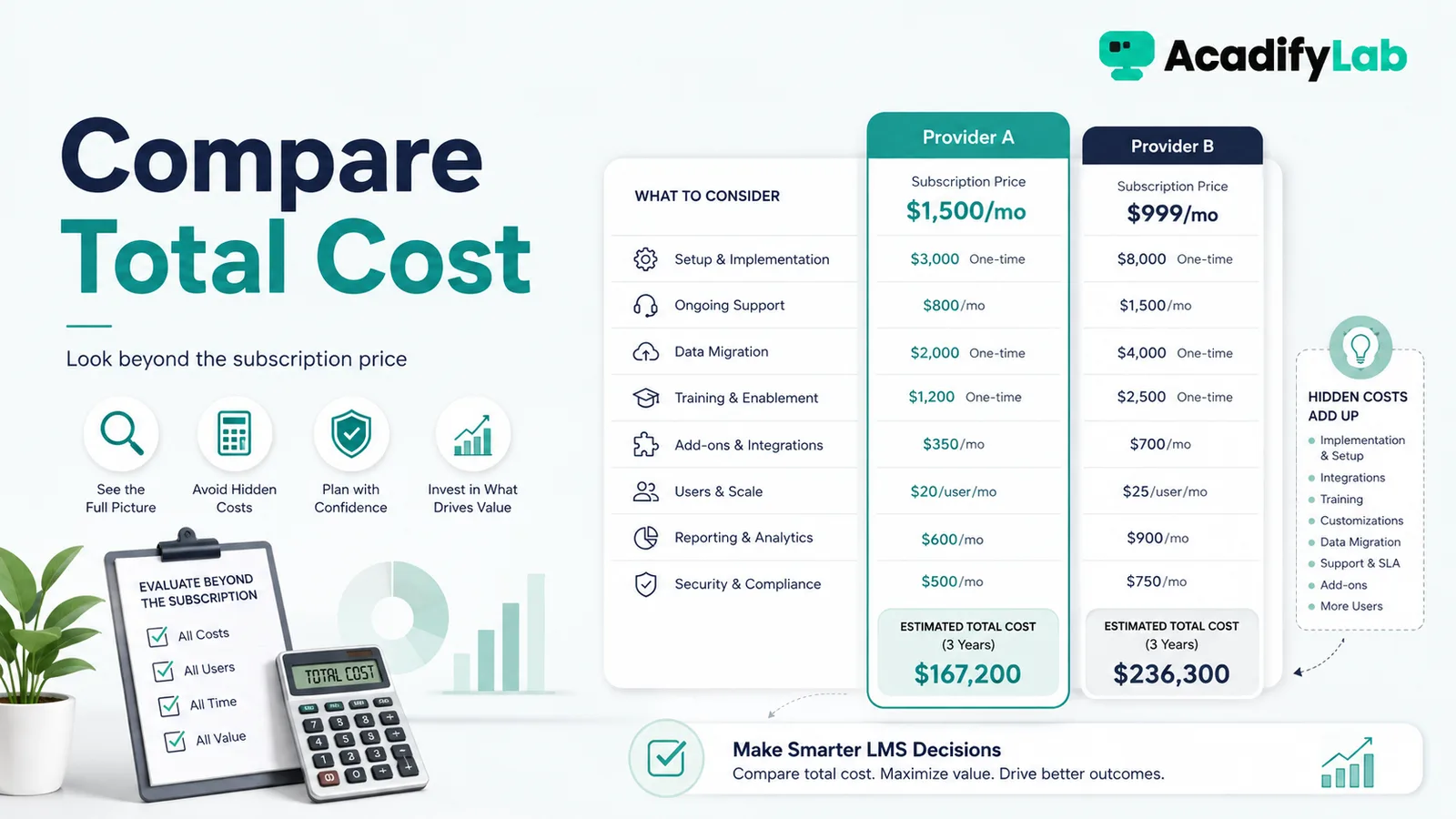
LMS pricing should be compared as total cost of ownership, not just the number on a pricing card. Subscription structure, active-user rules, revenue sharing, implementation, migration, storage, apps, integrations and support can materially change the real cost.
The honest comparison is not between two subscription figures. It is between two twelve-month totals, and the gap between those two numbers is where most LMS software pricing decisions go wrong. This guide sets out the models you will meet, the costs that sit outside the plan, and a way to model a realistic year before you commit.
Common pricing models
Use the following points as a working checklist for coaching institutes:
- Flat monthly or yearly subscription
- Registered-user pricing
- Active-user pricing
- Per-course or per-seat licensing
- Revenue-share or transaction model
- Custom enterprise contract
How the models compare at different sizes
| Model | Cheapest when | Expensive when | Watch for |
|---|---|---|---|
| Flat subscription | Learner numbers grow | You are small or seasonal | Feature gating between tiers |
| Registered-user | Few, long-term learners | You keep old accounts | Whether dormant accounts still count |
| Active-user | Seasonal cohorts | Steady year-round use | The definition of “active” — it varies by vendor |
| Per-seat / per-course | A narrow catalogue | The catalogue grows | Whether re-enrolment is charged again |
| Revenue share | Revenue is low | Revenue is high | It scales with success, not usage |
Note the asymmetry in the last row. Every other model is priced on what you use; a revenue share is priced on what you earn. Two businesses with identical usage can pay very different amounts.
Look for costs outside the plan
Ask about setup, migration, branded apps, storage or streaming, additional admins, integrations, API access, messaging, payment fees and premium support.
Match pricing to usage pattern
A trainer with seasonal cohorts has a different cost profile from a coaching chain with year-round learners or an enterprise with large but intermittent training populations.
Calculate the cost of operational work
A cheap platform may require more staff time, manual exports or separate tools. Include those recurring processes when comparing alternatives.
Model a realistic year
Estimate your expected learner pattern, number of programs, live-learning needs and add-ons for twelve months. Compare monthly flexibility with annual discounts and contract terms.
Questions that change the quote
Ask these before comparing any two prices, because each one can move a total by a wide margin:
- How is an “active user” defined, and when is the count taken?
- Do dormant or graduated accounts still count towards the tier?
- Is a branded mobile app included, or a paid add-on?
- Is there a cap on storage or live-class hours, and what happens when you pass it?
- Is migration from your current system chargeable?
- Is there a revenue share or transaction fee on top of the subscription?
- What does support cost once onboarding ends?
A worked method for modelling a year
- Write down your actual learner numbers for the last twelve months, month by month. Use real figures, not a growth target.
- Apply each vendor’s model to those same twelve numbers.
- Add the fixed extras: apps, storage overage, integrations, support.
- Add your own staff time for anything the platform does not automate, priced at what that time is worth.
- Compare the totals, then repeat the exercise at double your current size to see which model turns hostile as you grow.
Step five is the one people skip, and it is the one that catches revenue-share models.
Test before committing
Use a trial or demo to validate critical workflows before focusing on price. A low price for a platform that does not fit creates switching cost later.
AcadifyLab context
AcadifyLab publicly states monthly and yearly plans, a 7-day free trial, no setup fee and zero revenue sharing. Buyers should check the live pricing page for the current plan details and inclusions before publishing or purchasing.
Related AcadifyLab resources
Explore the AcadifyLab features overview and the relevant solution page for your use case.
How to build an online course platform: three routes compared
Next step
Once the workflow fit is clear, compare the current plan structure and total operating cost for your expected usage.
Frequently asked questions
What are common LMS pricing models?
Flat subscriptions, per-user, active-user, per-seat, revenue-share and custom enterprise contracts are common models.
What is total cost of ownership for an LMS?
It includes subscription plus implementation, migration, apps, integrations, storage, support, messaging, payment costs and staff effort.
Is annual LMS billing always cheaper?
Many vendors discount annual billing, but contract flexibility and actual usage should also be considered.
What does zero revenue sharing mean?
It means the LMS vendor does not take a percentage of your course revenue as its platform charge, although payment-gateway fees may still apply.
How should institutes compare quotes?
Model a realistic year using the same assumptions for users, add-ons and services across vendors.
Conclusion
Compare twelve-month totals at your real numbers, then again at twice your size. Most LMS software pricing looks similar at the point of sale and diverges sharply a year later, and the divergence is usually caused by one of three things: how active users are counted, what sits outside the plan, and whether the vendor takes a share of your revenue. Get those three answers in writing and the comparison becomes arithmetic rather than judgement.